Publications

List of publications and related information

Nayanika Das Presents Advances in GPX6 Catalysis at ACS Fall 2026

By |2026-09-01T09:33:30+00:00September 1, 2026|CBBL News, Conferences, PhD, Publications, Research|

Our PhD researcher, Nayanika Das, presented her work at ACS Fall 2026, the American Chemical Society’s national meeting held in Chicago from August 23 to 27, 2026, during the in-person poster session of the Physical Chemistry (PHYS) Division.

Nayanika Das at the ACS Fall 2026 Chicago
Nayanika Das at ACS Fall 2026, Chicago (August 23–27, 2026).

Her contribution, entitled “Computational Analysis of the Free Energy Profile of the First Step of Glutathione Peroxidase 6 (GPX6) Catalysis: Insights into the Role of Selenocysteine and Species-Specific Variations” (Poster 1847, Paper ID 4516513), explores the molecular and evolutionary factors influencing GPX6 catalysis.

Using computational free-energy calculations, the study investigates the role of the catalytic residue—selenocysteine (Sec) or cysteine (Cys)—and species-specific sequence variations. It further examines how interactions between mutations, or epistasis, can influence catalytic properties and contribute to protein evolution.
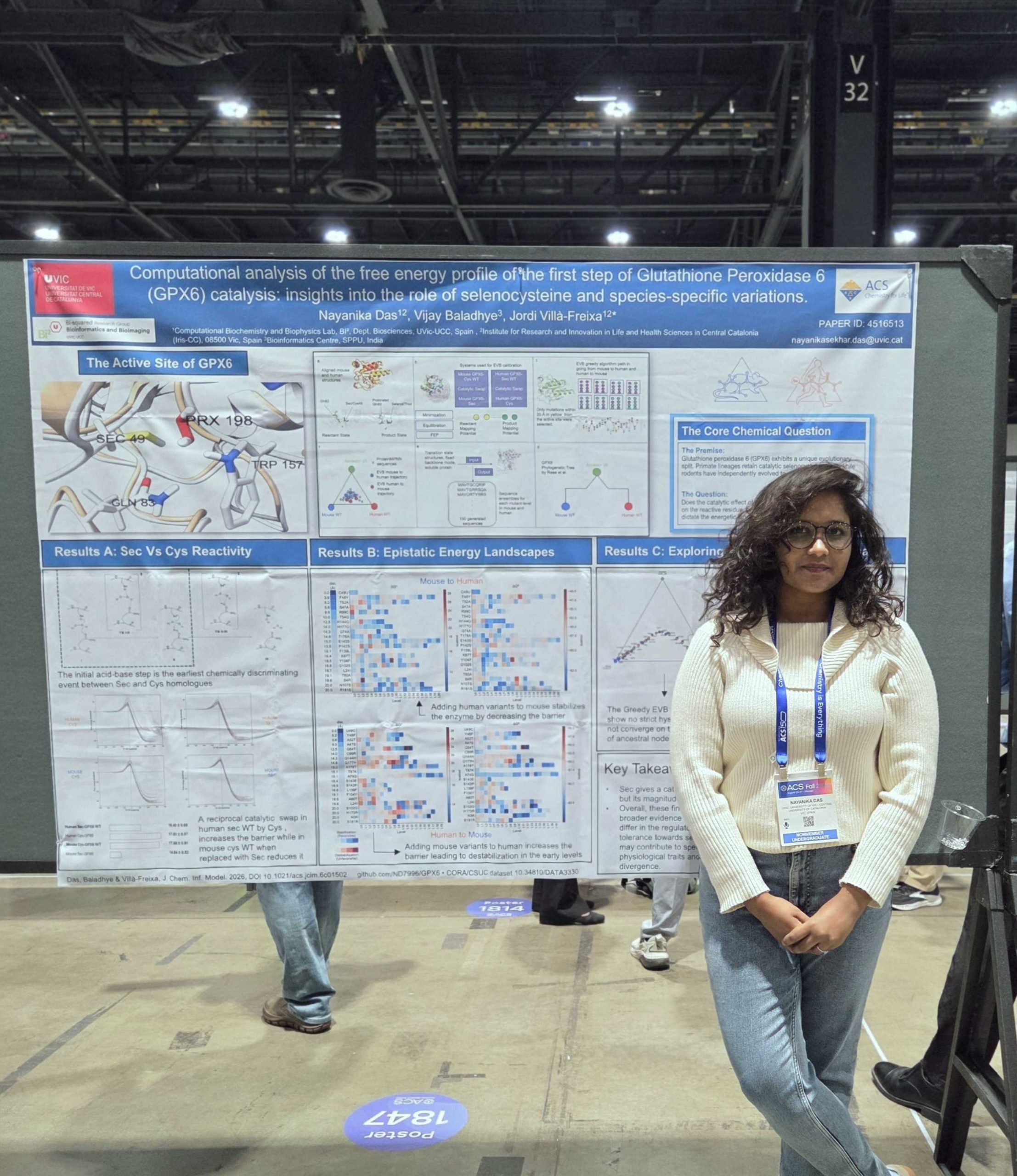
Nayanika Das next to her poster on GPX6 catalysis during the ACS Fall 2026 poster session
Presenting poster 1847 during the PHYS Division poster session.

The conference provided an excellent opportunity to share this research with an international scientific community and engage in discussions across computational chemistry, biochemistry, and molecular sciences.

The work presented builds on the lab’s related study on GPX6 catalysis, published in the Journal of Chemical Information and Modeling (DOI: 10.1021/acs.jcim.6c01502), with code and analysis openly available on GitHub and the underlying dataset deposited in the CORA/CSUC repository.

Nayanika’s participation in ACS Fall 2026 marks an important milestone in her doctoral research at the intersection of computational chemistry, protein catalysis, and molecular evolution. She gratefully acknowledges COZYME and IRIS-CC for providing the grants that made her participation possible.
EVB Free-Energy Landscapes Reveal Epistasis in GPX6 Evolution

By |2026-09-01T09:33:45+00:00July 21, 2026|CBBL News, PhD, Publications, Research|

A new study from the Computational Biochemistry and Biophysics Lab uses empirical valence bond simulations to show that the catalytic advantage of selenocysteine in GPX6 is not fixed: it depends on the surrounding protein sequence.

  • Article: Epistatic Modulation of Sec/Cys Catalysis in GPX6 Revealed by EVB Free-Energy Landscapes
  • Authors: Nayanika Das, Vijay Baladhye, Jordi Villà-Freixa
  • Journal: Journal of Chemical Information and Modeling
  • DOI: 10.1021/acs.jcim.6c01502
Human GPX6 keeps selenocysteine at its catalytic site, while rodent GPX6 lineages use cysteine. The study asks whether this is a simple residue swap or a deeper evolutionary reorganization. EVB simulations quantified the proton-transfer step that creates the reactive selenolate or thiolate species in human and mouse GPX6 variants.When a catalytic residue is not the whole storyThe same catalytic substitution can have different energetic consequences in different sequence backgrounds, a clear sign of epistasis in enzyme evolution.

Selenium often gives enzymes a chemical advantage. In glutathione peroxidases, selenocysteine can form a highly reactive selenolate, helping the enzyme reduce peroxides. GPX6 is especially informative because mammals have not all kept the same solution: primate GPX6 retains catalytic selenocysteine, whereas rodents and several other mammalian lineages have independently shifted to cysteine.

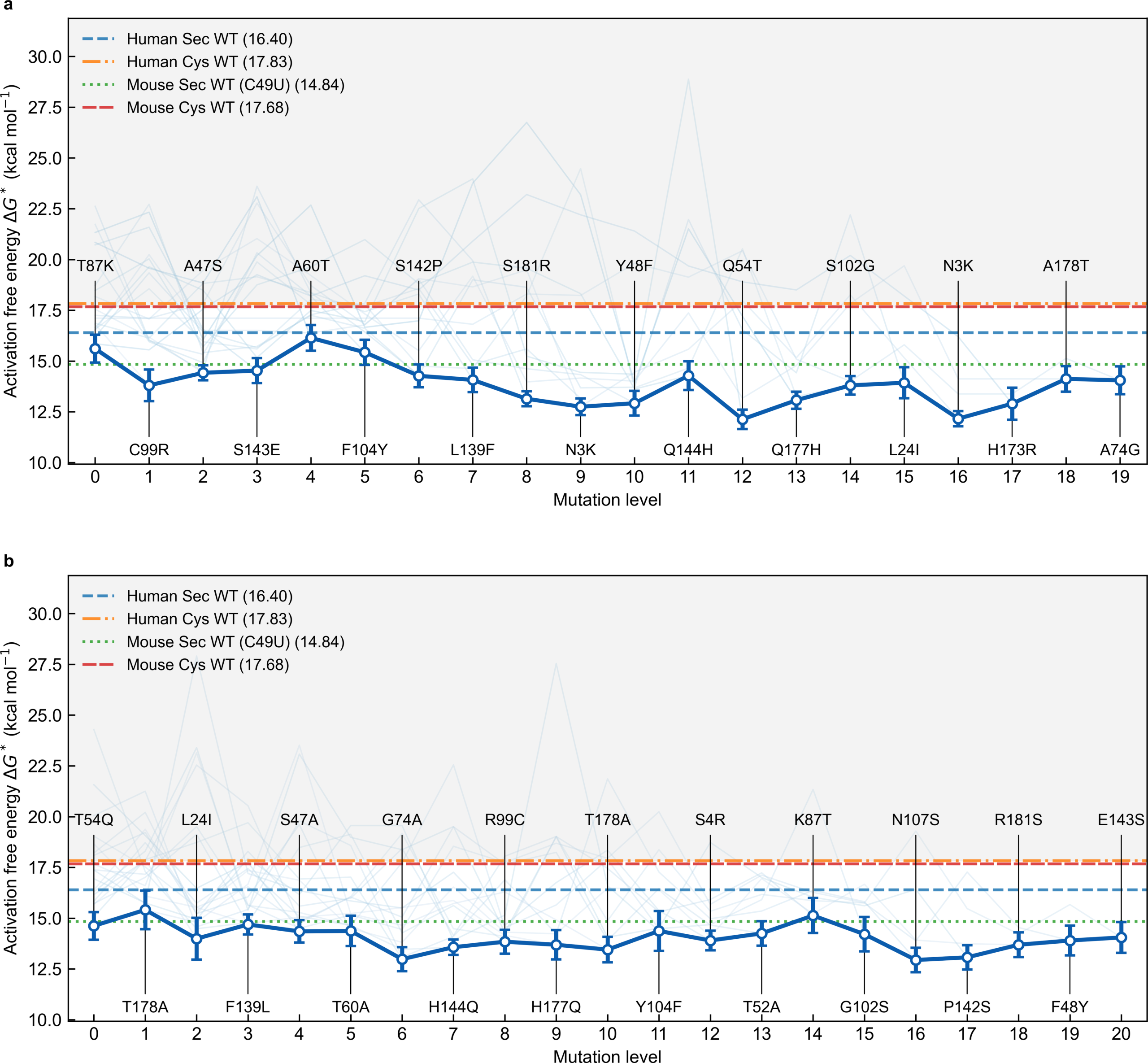
The new work shows that this evolutionary change cannot be understood by looking only at the catalytic atom. In the human protein, replacing selenocysteine with cysteine raises the activation barrier for the modeled proton-transfer step by 1.43 kcal mol-1. In the mouse protein, introducing selenocysteine lowers the barrier by 2.84 kcal mol-1. The chemistry of selenium matters, but the protein scaffold decides how much it matters.

Epistasis seen through free-energy landscapes

Nayanika Das then explored 20 substitutions close to the catalytic site and used EVB-derived activation barriers to identify energetically accessible paths between human and mouse GPX6. The result is a molecular view of epistasis: a substitution can be favorable, neutral, or unfavorable depending on the other residues already present.

This helps explain why rodent Cys-GPX6 should not be interpreted as a simple loss of selenium chemistry. Instead, the calculations support a model in which the rodent enzyme accumulated compensatory changes that help support catalysis with cysteine. Evolution appears constrained by the energetic landscape, but not locked into a single irreversible route.

The study represents a strong example of how detailed molecular simulations can connect catalytic chemistry with evolutionary history.

Why EVB matters for enzyme evolution and design

Empirical valence bond simulations are useful here because they translate sequence changes into changes in reaction free energy and activation barriers. That makes it possible to ask not only which mutations are present in evolution, but how they reshape the chemical step that an enzyme must perform.

This has implications beyond GPX6. For evolutionary enzymology, EVB can help identify compensatory mutations, alternative mutational routes, and sequence backgrounds where a catalytic residue change becomes viable. For enzyme design, the same logic suggests a practical strategy: use sequence or structure-based models to propose variants, then use EVB to rank them by their predicted catalytic barriers in more than one protein background.

The study therefore positions EVB as a bridge between molecular mechanism, evolutionary contingency, and future enzyme engineering. It shows that catalytic design should not treat active-site substitutions as isolated edits, but as changes whose success depends on the full energetic context of the protein.

Lab members participate in an article to uncover the hidden role of key inflammatory protein in stem cell function

By |2026-09-01T09:35:22+00:00July 22, 2025|CBBL News, Publications|

In a recent article (1), the lab, including our colleague at the UVic-UCC Joan Bertran Comulada, has contributed to characterize how a well-known immune regulator, IκBα, has a surprising second role in the cell — one that could open new doors for understanding and treating inflammation, cancer, and tissue regeneration.

For decades, IκBα has been recognized as the main “off switch” of the NF-κB pathway, a critical system that controls inflammation and immune responses. Some years ago, the lab contributed to an article (2) by the team of Lluís Espinosa and coworkers at the IMIM/UPF revealing that IκBα also works inside the cell nucleus, where it interacts with DNA and chromatin to regulate genes that control stem cell identity and differentiation.

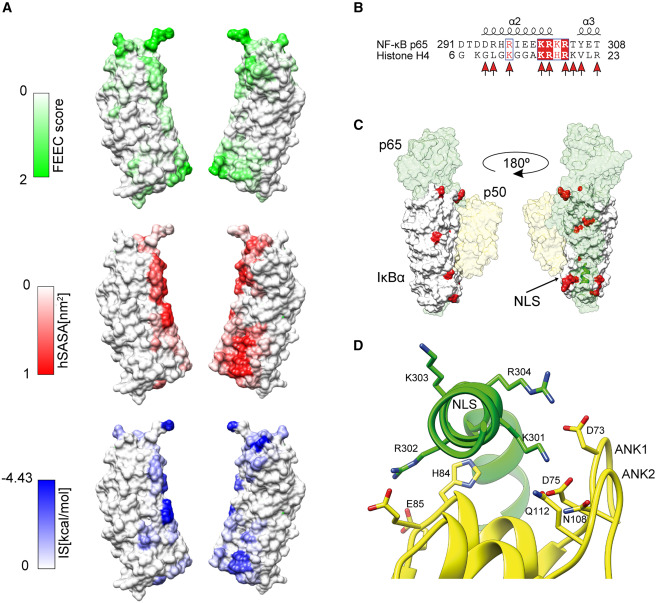
Using an innovative computational tool developed by Martin Floor while a PhD student in the CBBL, called the Fold-Excluded Evolutionary Conservation (FEEC) metric, we identified the exact regions of the protein responsible for each activity. In the study, the researchers looked not only at which parts of the protein are conserved across species, but also at how each residue fits within the protein’s 3D structure. By comparing evolutionary conservation with structural packing, they identified positions that are more conserved than expected based on their structural role. These positions may have additional regulatory or interaction functions, beyond simply maintaining the protein’s stability.

Having identified specific residues responsible for each activity prompted the creation, in this new research, of separation-of-function (SOF) mutants — engineered versions of IκBα that can perform either its traditional NF-κB–related function or its newly discovered chromatin-related one, but not both.

Figure 1 A common domain of IκBα is required for p65-NF-κB and histone H4 binding (1)

The subsequent experimental validation by Espinosa’s lab showed that the chromatin-associated form of IκBα is essential in intestinal stem cells, for their ability to mature into specialized cell types. This effect is independent of IκBα’s inflammatory role, highlighting its distinct influence on gene regulation and tissue health.

These findings redefine IκBα as more than just an inflammation inhibitor — it is also a key epigenetic regulator linking environmental signals to gene expression. The newly developed SOF mutants offer powerful tools to explore IκBα’s dual roles in health and disease and may guide the development of targeted therapies that fine-tune inflammation and regeneration without unwanted side effects.

1) Separation-of-function mutants reveal the NF-κB-independent involvement of IκBα in the regulation of intestinal stemness
Álvarez-Villanueva, Daniel et al.
Cell Reports, Volume 44, Issue 7, 115949, 2025

2) Chromatin-Bound IκBα Regulates a Subset of Polycomb Target Genes in Differentiation and Cancer
Mulero, María Carmen et al.
Cancer Cell, Volume 24, Issue 2, 151 – 166, 2013

New article on data analysis of freshwater pond’s nutrients in response to environmental variables

By |2026-09-01T09:35:40+00:00June 11, 2025|CBBL News, PhD, Publications|

Ponds are vital freshwater ecosystems that support rich biodiversity and provide important services to people and nature. However, they are still often overlooked in studies on land use and climate change. To better understand how these small but important water bodies are affected, we have collaborated in the data analysis from 240 ponds, surveyed across eight countries—seven in Europe and one in South America (Uruguay).

The study, published in the journal Hydrobiologia (Bartrons, 2025), examined how a combination of pond-specific features, surrounding land use, livestock activity, and climate patterns influence the concentrations of key nutrients, such as nitrogen and phosphorus. Results showed that the structure of the ponds themselves plays a major role: shallow ponds and those that dry out quickly (short hydroperiods) tended to have higher levels of both nitrogen (TN) and phosphorus (TP). In contrast, deeper ponds that stratify thermally (form temperature layers) had higher nitrogen levels, likely due to internal recycling of nutrients.

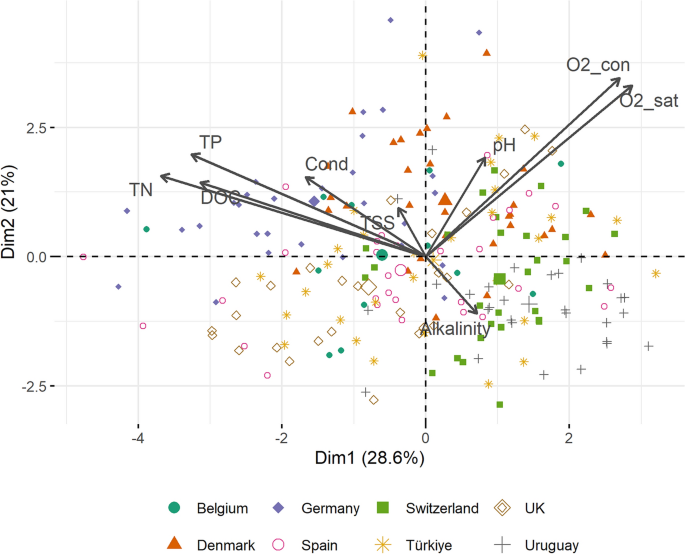
The first two ordination axes of a Principal Component Analysis (PCA) based on standardized mean annual physical and chemical variables in the ponds (points). The larger symbols in the plot represent the centroids (group means) for each country, indicating the central tendency of that group in the ordination space (Bartrons, 2025).

The surrounding landscape also mattered. Ponds in agricultural areas had elevated nutrient levels, while those near forests showed lower phosphorus concentrations. Seasonal changes further shaped these patterns—phosphorus levels were typically highest in summer, while nitrogen was diluted during wetter, cooler periods, especially in semi-permanent ponds.

Overall, the study led by our collaborator Mireia Bartrons, from the Aquatic Ecology Research Group at the FCTE, and with participation of two members of the lab including PhD student Jing Yang as a co-first author, highlights how pond health is shaped by a complex interplay of physical characteristics, land use, and climate. These findings emphasize the urgent need to better protect and manage ponds within broader environmental and land-use policies.

Cite:
(Bartrons, 2025) Bartrons, M., Yang, J., Cuenca‑Cambronero, M. et al. Why ponds concentrate nutrients: the roles of internal features, land use, and climate. Hydrobiologia (2025). https://doi.org/10.1007/s10750-025-05907-0

Roger Casals co-authors a Benchmarking study on Multimodal Gene Regulatory Networks

By |2026-09-01T09:35:56+00:00December 27, 2024|CBBL News, News, PhD, Publications|

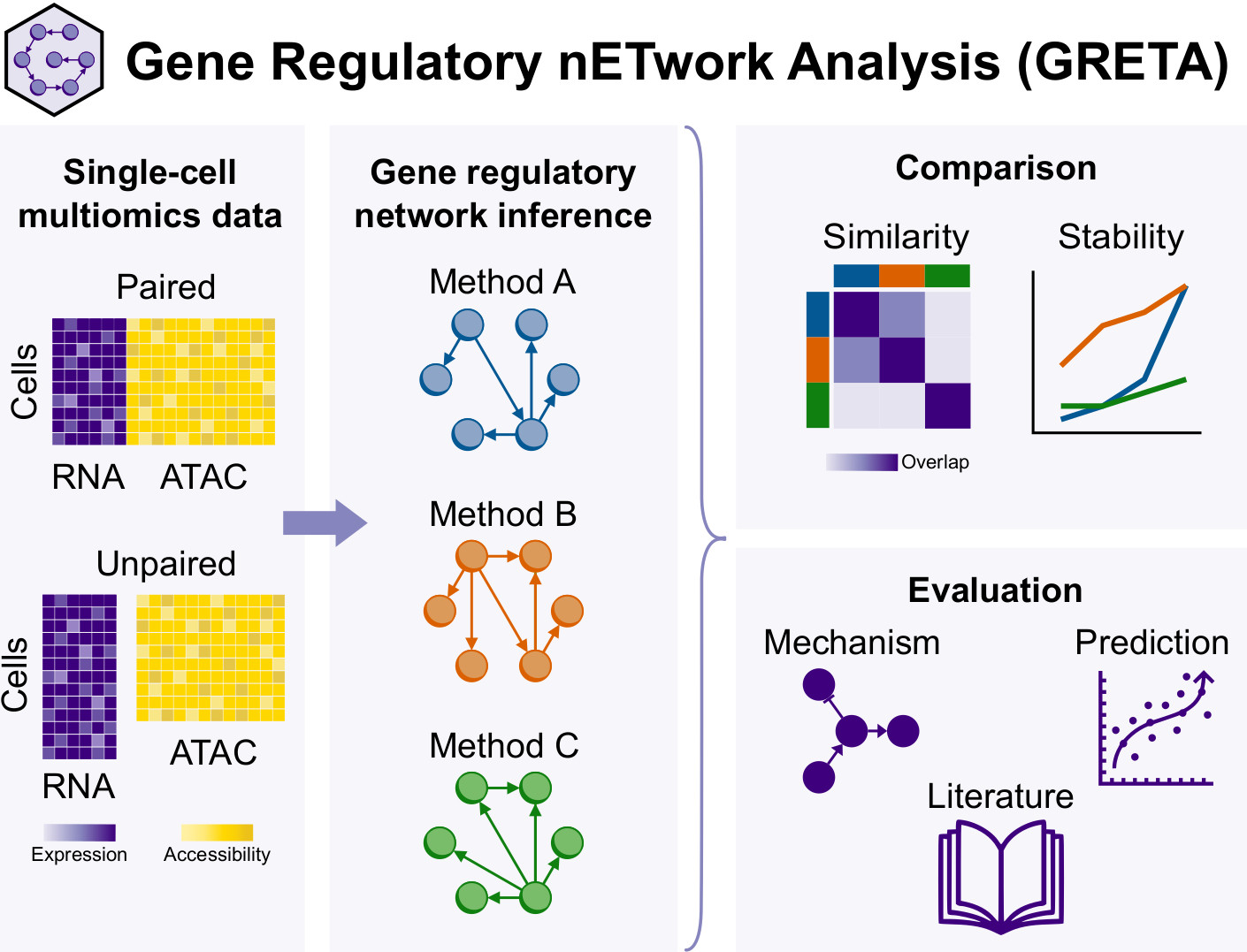
We are thrilled to announce the publication of a new preprint, “Comparison and evaluation of methods to infer gene regulatory networks from multimodal single-cell data”, led by Pau Badia-i-Mompel as the first author, with contributions from Roger Casals and the Saez-Lab team.

In this work, we present Gene Regulatory nETwork Analysis (GRETA), a comprehensive framework designed to infer, compare, and evaluate gene regulatory networks (GRNs). Using GRETA, we benchmarked both multimodal and unimodal GRN inference methods, setting a foundation for future advancements in the field.

GRETA graphical abstract

This preprint is an important step in understanding multiomic gene regulatory networks and reflects the collaborative efforts of the Saez-Lab, under the leadership of Julio Saez-Rodriguez.

Check out the results and tools here:

If you want to stay updated or join the discussion, check out our announcement on BlueSky.


Polyrate 2023: new version announcement

By |2026-09-01T09:37:06+00:00September 8, 2023|CBBL News, Publications|

Polyrate is a suite of computer programs for the calculation of chemical reaction rates of polyatomic species (including atoms and diatoms as special cases) by variational transition state theory (VTST); conventional transition state theory is also supported. The Polyrate suite has been developed by Donald Truhlar and coworkers for several decades and it is the reference tool for the calculation of both bimolecular reactions and unimolecular reactions, and it can be applied to reactions in the gas phase, liquid solution phase, or solid state and to reactions at gas–solid interfaces.

The participation of the members of the CBBL in the program was in the development of the re-orientation of the dividing surface (RODS) [1,2] algorithm that allow VTST calculations with larger step sizes.

[1] J. Villà, D.G. Truhlar, Theor. Chem. Acc. 97 (1997) 317-323, https://doi.org/10.1007/s002140050267.

[2] A. González-Lafont, J. Villà, J.M. Lluch, J. Bertrán, R. Steckler, D.G. Truhlar, J. Phys. Chem. A 102 (1998) 3420-3428, https://doi.org/10.1021/jp9807672.

REF:

Meana-Pañeda, Rubén; Zheng, Jingjing; Bao, Junwei Lucas; Zhang, Shuxia; Lynch, Benjamin J.; Corchado, José C.; Chuang, Yao-Yuan; Fast, Patton L.; Hu, Wei-Ping; Liu, Yi-Ping; Lynch, Gillian C.; Nguyen, Kiet A.; Jackels, Charles F.; Fernández-Ramos, Antonio; Ellingson, Benjamin A.; Melissas, Vasilios S.; Villà, Jordi; Rossi, Ivan; Coitiño, Elena L.; Pu, Jingzhi; Albu, Titus V.; Zhang, Rui Ming; Xu, Xuefei; Ratkiewicz, Artur; Steckler, Rozeanne; Garrett, Bruce C.; Isaacson, Alan D.; Truhlar, Donald G.

Polyrate 2023: A computer program for the calculation of chemical reaction rates for polyatomics. New version announcement Journal Article

In: Computer Physics Communications, vol. 294, pp. 108933, 2024, ISSN: 0010-4655.

CDK6 is activated by the atypical cyclin I to promote E2F‐mediated gene expression and cancer cell proliferation

By |2026-09-01T09:37:19+00:00June 1, 2023|CBBL News, Publications|

A paper has been just published in Molecular Oncology in a collaboration led by our colleagues Josep Clotet and Mariana P. Ribeiro (UIC Barcelona) on the interaction of CDK6 with the atypical cyclin I. The CBBL has contributed with molecular modelling analysis of the interface region. Martin Floor and Pau MArc Muñoz, past members of the CBBL, did all the computational work.

Abstract: Cyclin-dependent kinases (CDKs), together with their cyclin partners, are the master cell cycle regulators. Remarkably, the cyclin family was extended to include atypical cyclins, characterized by distinctive structural features, but their partner CDKs remain elusive. Here, we conducted a yeast two-hybrid screen to identify new atypical cyclin–CDK complexes. We identified 10 new complexes, including a complex between CDK6 and cyclin I (CCNI), which was found to be active against retinoblastoma protein. CCNI upregulation increased the proliferation of breast cancer cells in vitro and in vivo, with a magnitude similar to that seen upon cyclin D upregulation, an effect that was abrogated by CDK6 silencing or palbociclib treatment. In line with these findings, CCNI downregulation led to a decrease in cell number and a reduction in the percentage of cells reaching S phase. Finally, CCNI upregulation correlated with the high expression of E2F target genes in large panels of cancer cell lines and tissue samples from breast cancer patients. In conclusion, we unveil CCNI as a new player in the pathways that activate CDK6, enriching the wiring of cell cycle control..

Ancient loss of catalytic selenocysteine spurred convergent adaptation in a mammalian oxidoreductase

By |2026-09-01T09:37:51+00:00January 10, 2023|CBBL News, Publications|

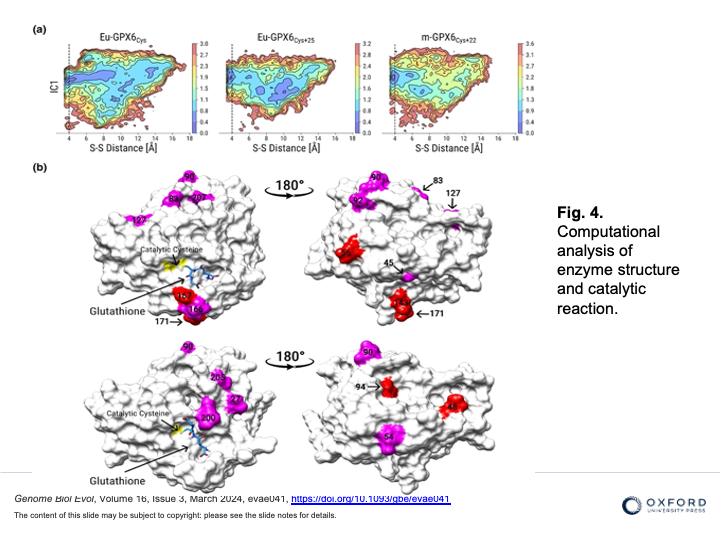
Selenocysteine (Sec), the 21st amino acid specified by the genetic code, is a rare selenium-containing residue found in the catalytic site of selenoprotein oxidoreductases. Sec is analogous to the common cysteine (Cys) amino acid but its selenium atom offers physicalchemical properties not provided by the corresponding sulfur atom in Cys. Catalytic sites with Sec in selenoproteins of vertebrates are under strong purifying selection but one enzyme, Glutathione Peroxidase 6 (GPX6), independently exchanged Sec for Cys less than one hundred million years ago in several mammalian lineages. We reconstructed and assayed these ancient enzymes before and after Sec was lost and up to today, and found them to have lost their classic ability to reduce hydroperoxides using glutathione (GSH). This loss of function, however, was accompanied by bursts of amino acid changes in the catalytic domain, with protein sites concertedly changing under positive selection across distant lineages abandoning Sec in GPX6. This demonstrates that when sulfur in Cys impairs catalysis a narrow evolutionary path is followed, with epistasis and pleiotropy leading to convergent evolution and triggering enzymatic properties likely beyond those in classic GPXs. These findings are an unusual example of adaptive convergence towards unexplored oxidoreductase functions during mammalian evolution.

  • Preprint: Ancient loss of catalytic selenocysteine spurred convergent adaptation in a mammalian oxidoreductase. Jasmin Rees, Gaurab Sarangi, Qing Cheng, Martin Floor, Aida M Andrés, Baldomero Oliva Miguel, Jordi Villà-Freixa, Elias SJ Arnér, Sergi Castellano BioRxiv doi: https://doi.org/10.1101/2023.01.03.522577
  • Published article: Ancient Loss of Catalytic Selenocysteine Spurred Convergent Adaptation in a Mammalian Oxidoreductase. Jasmin Rees, Gaurab Sarangi, Qing Cheng, Martin Floor, Aida M Andrés, Baldomero Oliva Miguel, Jordi Villà-Freixa, Elias S J Arnér, Sergi Castellano Genome Biology and Evolution, Volume 16, Issue 3, March 2024, evae041, https://doi.org/10.1093/gbe/evae041

Dynamic chromatin association of IκBα is regulated by acetylation and cleavage of histone H4

By |2026-09-01T09:37:56+00:00December 20, 2021|CBBL News, Publications|

IκBs exert principal functions as cytoplasmic inhibitors of NF-kB transcription factors. Additional roles for IκB homologues have been described, including chromatin association and transcriptional regulation. Phosphorylated and SUMOylated IκBα (pS-IκBα) binds to histones H2A and H4 in the stem cell and progenitor cell compartment of skin and intestine, but the mechanisms controlling its recruitment to chromatin are largely unknown. In a recent paper led by Lluís Espinosa at IMIM, the team showed that serine 32–36 phosphorylation of IκBα favors its binding to nucleosomes and demonstrate that p-IκBα association with H4 depends on the acetylation of specific H4 lysine residues. The N-terminal tail of H4 is removed during intestinal cell differentiation by proteolytic cleavage by trypsin or chymotrypsin at residues 17–19, which reduces p-IκBα binding. Inhibition of trypsin and chymotrypsin activity in HT29 cells increases p-IκBα chromatin binding but, paradoxically, impaired goblet cell differentiation, comparable to IκBα deletion. Taken together, the results indicate that dynamic binding of IκBα to chromatin is a requirement for intestinal cell differentiation and provide a molecular basis for the understanding of the restricted nuclear distribution of p-IκBα in specific stem cell compartments.

In summary:

Nuclear IκBα preferentially binds the acetylated N-terminal tail of histone H4 in vivo, specifically in the skin and intestine stem cell compartments. N-terminal cleavage of histone H4 facilitates IκBα dissociation and cellular differentiation.

    • Nuclear IκBα binds the acetylated N-terminal tail of histone H4.
    • The N-terminal tail of histone H4 is lost during cellular differentiation.
  • Histone H4 cleavage is likely produced by Trypsin and Chymotrypsin.
  • Cellular differentiation requires dynamic IκBα chromatin binding and dissociation.

Laura Marruecos, Joan Bertran, Daniel Álvarez-Villanueva, María Carmen Mulero, Yolanda Guillén, Luis G Palma, Martin Floor, Anna Vert, Sara Arce-Gallego, Irene Pecharroman, Laura Batlle, Jordi Villà-Freixa, Gourisankar Ghosh, Anna Bigas, Lluís Espinosa. Dynamic chromatin association of IκBα is regulated by acetylation and cleavage of histone H4. EMBO Reports (2021)22:e52649 2021 https://doi.org/10.15252/embr.202152649

See also comment by Maarten Dhaenens in EMBO Reports.

Selected publication: SBMOpenMM; A Builder of Structure-Based Models for OpenMM

By |2026-09-01T09:38:09+00:00December 20, 2021|CBBL News, PhD, Publications|

Molecular dynamics (MD) simulations have become a standard tool to correlate the structure and function of biomolecules, and significant advances have been made in the study of proteins and their complexes. A major drawback of conventional MD simulations is the difficulty and cost of obtaining converged results, especially when exploring potential energy surfaces containing considerable energy barriers. This limits the wide use of MD calculations to determine the thermodynamic properties of biomolecular processes. Alternatively, a wide range of Structure-Based Models (SBMs) has been used in the literature to unravel the basic mechanisms of biomolecular dynamics. In a recent article in JCIM, we introduce SBMOpenMM, a Python library to build force fields for SBMs, that uses the OpenMM framework to create and run SBM simulations. The code is flexible, user-friendly, and profits from the high customizability and performance provided by the OpenMM platform.

SBMOpenMM: A Builder of Structure-Based Models for OpenMM

Martin Floor, Kengjie Li, Miquel Estévez-Gay, Luis Agulló, Pau Marc Muñoz-Torres, Jenn K. Hwang, Sílvia Osuna, and Jordi Villà-Freixa
Journal of Chemical Information and Modeling 2021 61 (7), 3166-3171

DOI: 10.1021/acs.jcim.1c00122

Go to Top