
A new study from the Computational Biochemistry and Biophysics Lab uses empirical valence bond simulations to show that the catalytic advantage of selenocysteine in GPX6 is not fixed: it depends on the surrounding protein sequence.
Selenium often gives enzymes a chemical advantage. In glutathione peroxidases, selenocysteine can form a highly reactive selenolate, helping the enzyme reduce peroxides. GPX6 is especially informative because mammals have not all kept the same solution: primate GPX6 retains catalytic selenocysteine, whereas rodents and several other mammalian lineages have independently shifted to cysteine.
The new work shows that this evolutionary change cannot be understood by looking only at the catalytic atom. In the human protein, replacing selenocysteine with cysteine raises the activation barrier for the modeled proton-transfer step by 1.43 kcal mol-1. In the mouse protein, introducing selenocysteine lowers the barrier by 2.84 kcal mol-1. The chemistry of selenium matters, but the protein scaffold decides how much it matters.
Epistasis seen through free-energy landscapes
Nayanika Das then explored 20 substitutions close to the catalytic site and used EVB-derived activation barriers to identify energetically accessible paths between human and mouse GPX6. The result is a molecular view of epistasis: a substitution can be favorable, neutral, or unfavorable depending on the other residues already present.
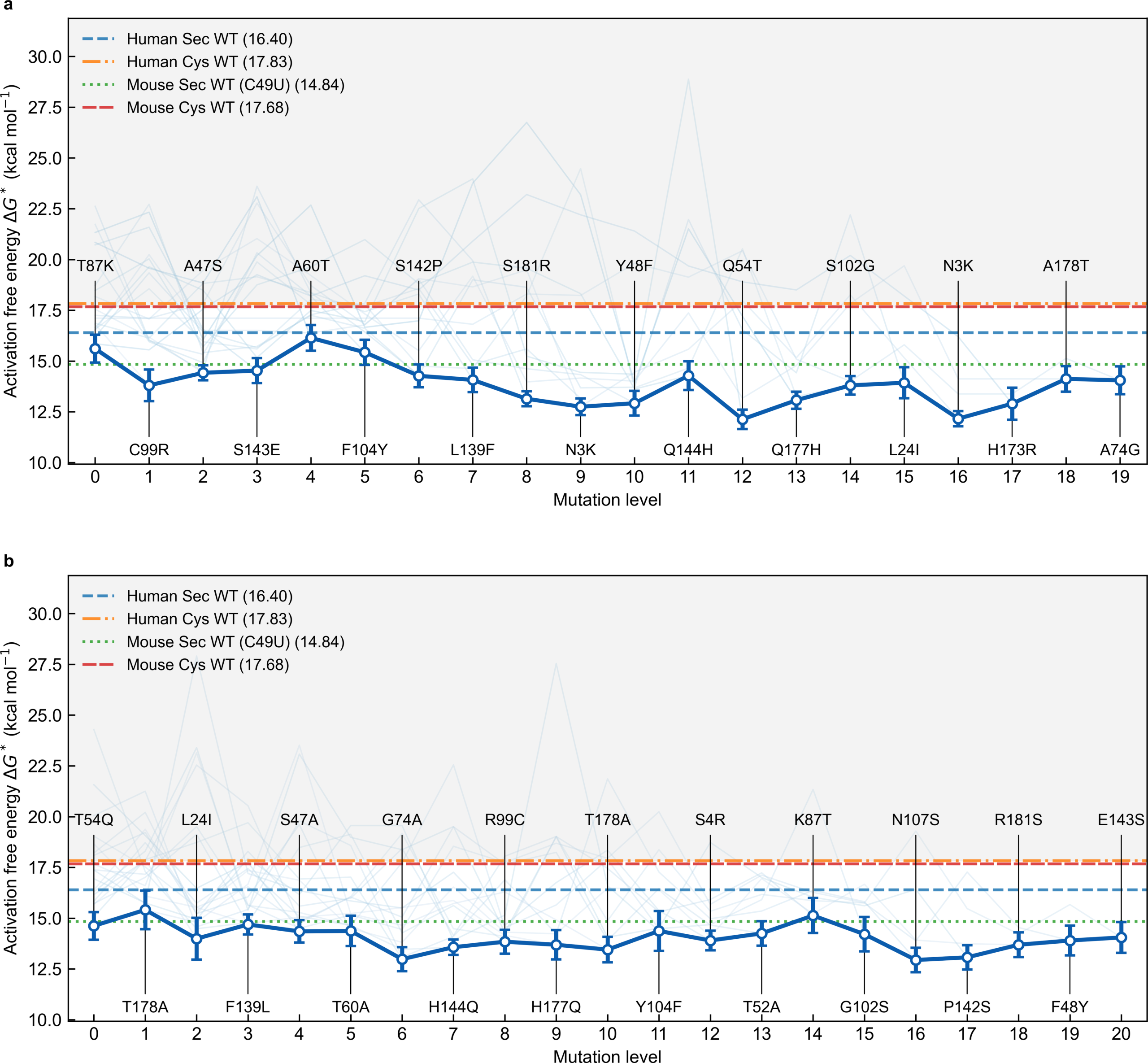
This helps explain why rodent Cys-GPX6 should not be interpreted as a simple loss of selenium chemistry. Instead, the calculations support a model in which the rodent enzyme accumulated compensatory changes that help support catalysis with cysteine. Evolution appears constrained by the energetic landscape, but not locked into a single irreversible route.
The study represents a strong example of how detailed molecular simulations can connect catalytic chemistry with evolutionary history.
Why EVB matters for enzyme evolution and design
Empirical valence bond simulations are useful here because they translate sequence changes into changes in reaction free energy and activation barriers. That makes it possible to ask not only which mutations are present in evolution, but how they reshape the chemical step that an enzyme must perform.
This has implications beyond GPX6. For evolutionary enzymology, EVB can help identify compensatory mutations, alternative mutational routes, and sequence backgrounds where a catalytic residue change becomes viable. For enzyme design, the same logic suggests a practical strategy: use sequence or structure-based models to propose variants, then use EVB to rank them by their predicted catalytic barriers in more than one protein background.
The study therefore positions EVB as a bridge between molecular mechanism, evolutionary contingency, and future enzyme engineering. It shows that catalytic design should not treat active-site substitutions as isolated edits, but as changes whose success depends on the full energetic context of the protein.