Scientific outreach

Roger Casals wins UVic-UCC’s ninth “Your Thesis in 4 Minutes” contest
By |2026-09-01T09:33:08+00:00May 14, 2026|CBBL News, PhD, Scientific outreach|

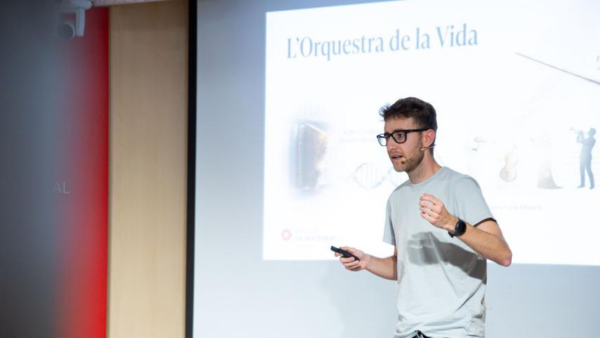
Roger Casals Franch presenting his thesis at UVic-UCC’s “Your Thesis in 4 Minutes” contest. Image: UVic-UCC / FCTE.

Roger Casals Franch, member of the CBBL and PhD candidate in the UVic-UCC Bioinformatics programme, has won the ninth edition of the University’s “Your Thesis in 4 Minutes” competition. The final took place in the Mercè Torrents room on the Vic campus and brought together fourteen doctoral candidates from the UVic-UCC Doctoral School.

Roger, who works at the Institute for Research and Innovation in Life Sciences and Health in Central Catalonia (IRIS-CC), is a Biotechnology graduate from the Universitat Autònoma de Barcelona and holds a master’s degree in Bioinformatics from the Universitat Oberta de Catalunya.

His awarded presentation, “Every cell tells a different story”, summarizes his thesis, focused on analysing how individual cells respond to the same disease or treatment. The research aims to better understand cellular diversity, a key factor for interpreting what is really happening inside the body.

The jury recognised Casals for presenting a clear, well-structured and accessible talk for a non-specialist audience. They also highlighted his ability to communicate enthusiasm, connect with the audience and hold their attention throughout the presentation.

As winner, Roger will represent UVic-UCC in the Catalan edition of “Present Your Thesis in 4 Minutes”, organised by the Catalan Foundation for Research and Innovation. The competition will bring together representatives from all Catalan universities and will take place on 11 June 2026 at the Pilarín Bayés Library auditorium in Vic.

Sources: FCTE news item and L’Apunt UVic-UCC news item.
The CBBL Organizes an Update Workshop on Omics Data Analysis at the UVic-UCC

By |2026-09-01T09:34:35+00:00December 19, 2025|CBBL News, Research, Scientific outreach, Teaching|

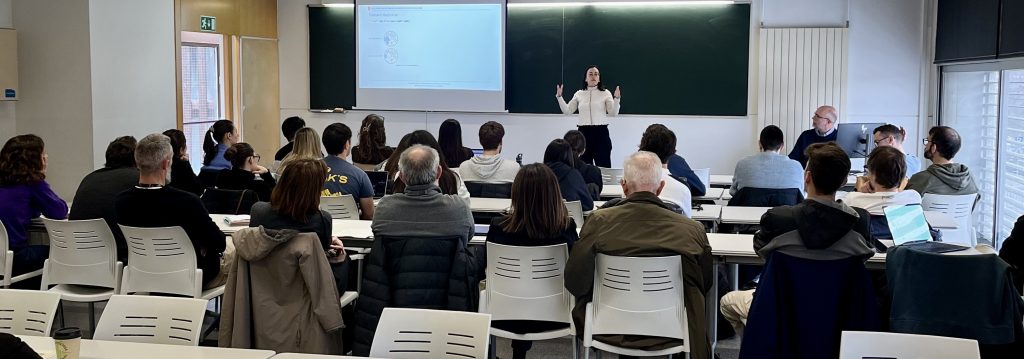
The Computational Biochemistry and Biophysics Laboratory (CBBL), part of the Bioinformatics and Bioimaging Research Group (Bi-Squared) at the University of Vic – Central University of Catalonia (UVic-UCC), in collaboration with the Central Catalonia Institute for Health Research (IRIS-CC), organized the workshop “Update in Omics Data Analysis: genome structure, metagenomics and gene regulation”. The session provided a forum to discuss and review recent developments in omics data analysis, aimed at researchers, students, and professionals in the field.

Held shortly before Christmas at the Torre dels Frares Campus in Vic, the event brought together postdoctoral researchers who presented and discussed recent advances in key areas of bioinformatics, including genome structure, metagenomics, and gene regulation using large-scale omics datasets. The workshop concluded with a round-table discussion that encouraged dialogue on emerging challenges and future directions in biological data analysis.

The program featured presentations by:

This workshop aligns with IRIS-CC’s outreach and training initiatives and supports scientific exchange and skills development within the bioinformatics and bioimaging research community.

For more information, please visit the event webpage: Update in Omics Data Analysis: genome structure, metagenomics and gene regulation.

Workshop on AI Applications in Biomedical Sciences

By |2026-09-01T09:36:21+00:00October 11, 2024|CBBL News, Scientific outreach|

The Bioinformatics and Bioimaging research area of the IRIS-CC and the Bi-Squared Research Group for Bioinformatics and Bioimaging (BI2) are pleased to announce the AI Applications in Biomedical Sciences workshop. The event will take place on Friday, November 15, 2024, at the Faculty of Medicine, UVIC-UCC (Can Baumann).

The workshop, which is free of charge, will run from 10:00 AM to 1:00 PM and will feature discussions on the latest advancements and applications of machine learning and artificial intelligence in the field of biomedical sciences.

Participants are required to register in advance for organizational purposes. For more information and to access the event program, visit the event page: AI Applications in Biomedical Science.

Event Details:

  • Date: November 15, 2024
  • Time: 10:00 AM – 1:00 PM
  • Location: Faculty of Medicine, UVIC-UCC, Can Baumann
  • Registration: Free, but mandatory through this form

Co-organized by


X Barril – UB – Structure-based drug design: Towards accurate predictions of thermodynamic and kinetic parameters

By |2026-09-01T09:39:29+00:00February 28, 2012|CBBL News, Scientific outreach|

Xavier Barril is visiting the PRBB this friday to give a seminar on the title topic.

Here it comes a short abstract of the talk:

The combination of increased availability of structural information, major boosts in computational power and methodological developments is
taking structure-based drug discovery to a higher level. I will present the main research lines of the group, focussing on the development of a new type of docking scoring functions and the elucidation of structure-kinetics relationships. Together with new experimental methods, these type of tools will enable the discovery of drugs with more diverse and effective mechanisms of action.

FRIDAY Nov.18th – 11h; Structural Biology Seminar (Dr. Agustí Emperador)

By |2026-09-01T09:39:47+00:00November 16, 2011|CBBL News, News, Research, Scientific outreach|

PRBB structural biology seminar

Dr. Agustí Emperador, Institut for Research in Biomedicine (IRB, Barcelona)

“Protein flexibility in docking with discrete molecular dynamics simulations”

The aim of protein-protein docking is to predict how two proteins associate to form a complex. This means determining where will be the interface. This is a complex problem with many degrees of freedom. To reduce the sampling space, in general both proteins are considered to be rigid bodies (rigid docking). This reduces the problem to 6 degrees of freedom (3 for translation and 3 for rotation). The rigid body docking is a rude approach, since the proteins have flexibility and may undergo relevant conformational changes upon binding to the other protein when forming the complex. We have used discrete molecular dynamics (DMD) simulations to include the protein flexibility in docking configurations, and we have improved the predictive power of the method. DMD is a simplified molecular dynamics method much faster than standard MD, specially for systems with less that 10^3 particles.

Friday, November 18th 2011; 11:00-12:00
Seminar Room “Xipre” 173.06 (PRBB – 1st floor)

Go to Top