
Teaching

Teaching by members of the CBBL

Course on molecular dynamics simulations in Concepción, Chile

By |2026-09-18T10:57:19+00:00January 28, 2026|CBBL News, Teaching|

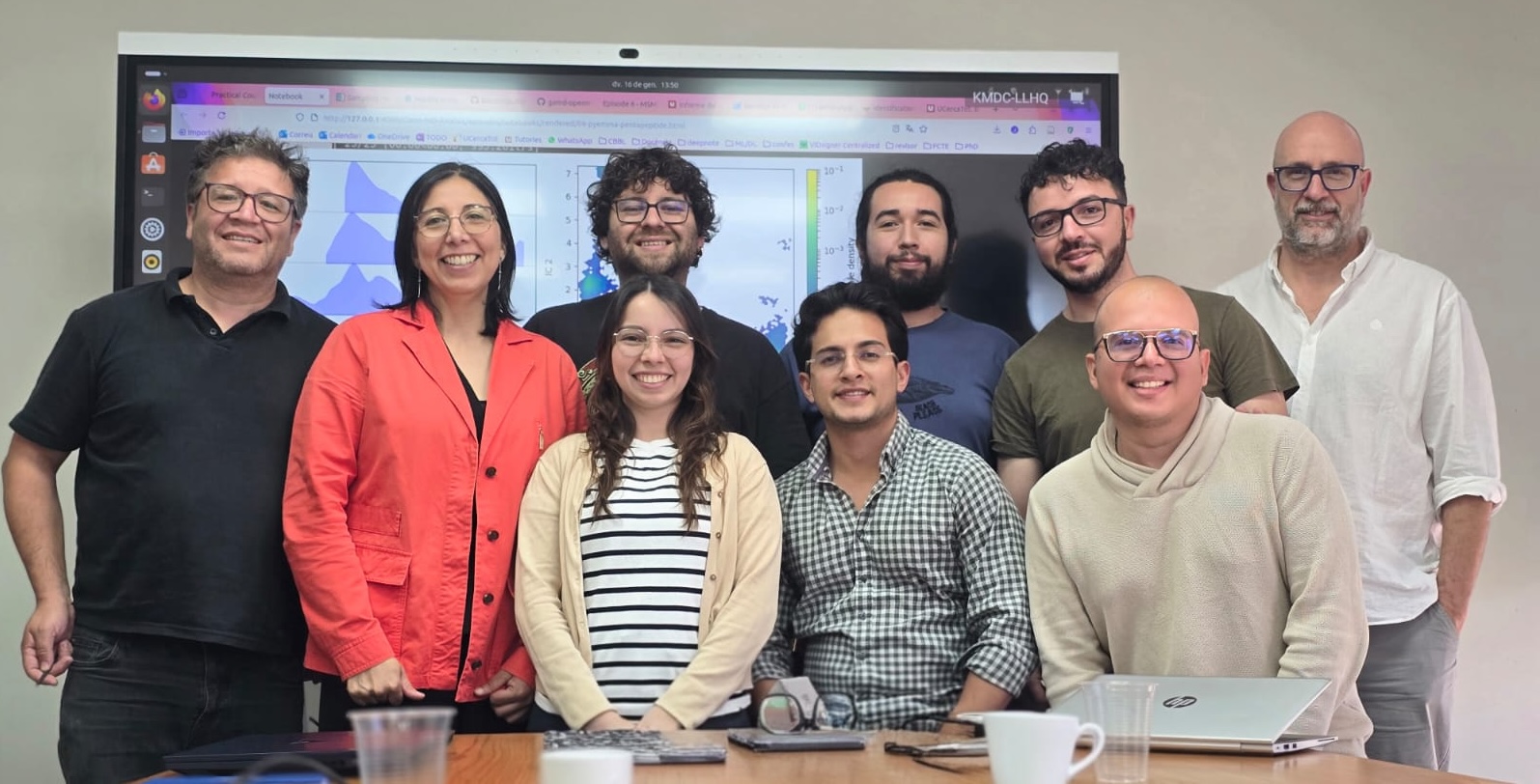
In January 15-19th, invited by the lab of Verónica Andrea Jimenez Curihual, at the Universidad Andrés Bello in its Concepción campus, Jordi Villà-Freixa taugth a course on molecular dynamics simulations with OpenMM and the posterior basic through advanced data analysis using standard tools like MDraj, MDAnalysis, pyemma or deeptime. Several PhD students and postdoctoral researchers (some shown in the picture) attended the course, that served as a way to build on the foundations of a long time collaborative bridge between the two labs.
The course web site and the source github repository are available under a MIT license.
 

The CBBL Organizes an Update Workshop on Omics Data Analysis at the UVic-UCC

By |2026-09-01T09:34:35+00:00December 19, 2025|CBBL News, Research, Scientific outreach, Teaching|

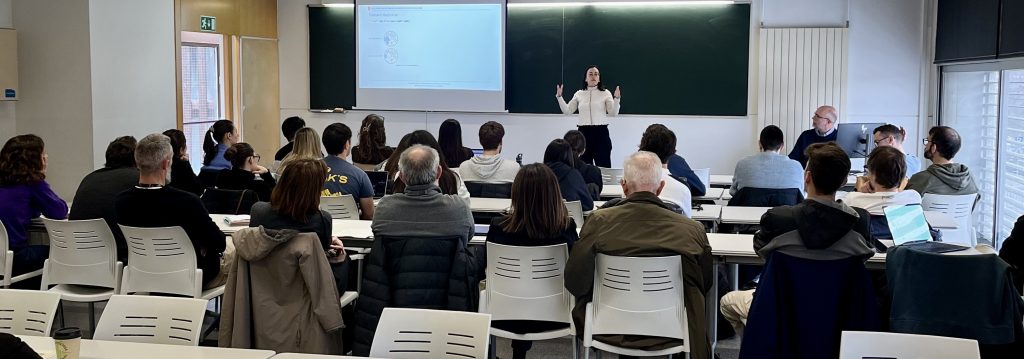
The Computational Biochemistry and Biophysics Laboratory (CBBL), part of the Bioinformatics and Bioimaging Research Group (Bi-Squared) at the University of Vic – Central University of Catalonia (UVic-UCC), in collaboration with the Central Catalonia Institute for Health Research (IRIS-CC), organized the workshop “Update in Omics Data Analysis: genome structure, metagenomics and gene regulation”. The session provided a forum to discuss and review recent developments in omics data analysis, aimed at researchers, students, and professionals in the field.

Held shortly before Christmas at the Torre dels Frares Campus in Vic, the event brought together postdoctoral researchers who presented and discussed recent advances in key areas of bioinformatics, including genome structure, metagenomics, and gene regulation using large-scale omics datasets. The workshop concluded with a round-table discussion that encouraged dialogue on emerging challenges and future directions in biological data analysis.

The program featured presentations by:

This workshop aligns with IRIS-CC’s outreach and training initiatives and supports scientific exchange and skills development within the bioinformatics and bioimaging research community.

For more information, please visit the event webpage: Update in Omics Data Analysis: genome structure, metagenomics and gene regulation.

Nurturing Science

By |2010-09-08T18:44:10+00:00September 8, 2010|Group, Teaching|

Coming back from vacations is never easy, and it is even worst in science. A lot of project proposals and articles to be written and conferences to be improved piled up in your laptop and you did not have the time to finnish even half of them. What is worst, that turn in your research you wanted time to think about didn’t come out as expected. Indeed, taking strong and deeply thought decisions is not an easy task while supervising your 6 to 11 years old kids in a rocky beach in the Costa Brava, climbing a Pyrenees mountain or enjoying a foam party in Vilamaniscle.

So fresh air is always welcome and I found it (as most good science) by chance at Uri Alon’s site. Afterwards (as happens also with most good science, unfortunately…) I realized his paper on “How to Choose a Good Scientific Problem” was extremely highly read. His “Materials for Nurturing Science” have started producing in me a similar effect as the reading of some Feynman’s lectures produced years ago, when a PhD student in Lluch’s and González-Lafont lab. Pessimistic views were (and periodically are) collapsing into what Alon refers as “the cloud”. But some readings and talks (veeeery few) lead us again to the right track, the one that was not initially drawn into our particular history. The wall, that I call sometimes (sorry, link in catalan). At any rate, spending some time having a look at Uri’s “Materials…” is an excellent therapy for the type of people that always reject any type of therapy: scientists…

Anyway, I think reading Uri’s paper and having some time to see his videos is an excellent start for any new PhD student or postdoctoral researcher in my lab, so here are the links for you, if you are thinking on spending the best years of your scientific career (and who knows if also of your life) at the CBBL.

Science, Language and Literacy

By |2010-05-03T08:10:32+00:00May 3, 2010|Teaching|

“Argument and debate are common in science, yet they are virtually absent from science education. Recent research shows, however, that opportunities for students to engage in collaborative discourse and argumentation offer a means of enhancing student conceptual understanding and students’ skills and capabilities with scientific reasoning. As one of the hallmarks of the scientist is critical, rational skepticism, the lack of opportunities to develop the ability to reason and argue scientifically would appear to be a significant weakness in contemporary educational practice. In short, knowing what is wrong matters as much as knowing what is right. This paper presents a summary of the main features of this body of research and discusses its implications for the teaching and learning of science.”
Jonathan Osborne

These are words taken from the abstract of one of the articles devoted to Science, Language and Literacy in the special issue of Science Magazine. An unavoidable reading for all those engaged on teaching science, but not just that…

Design and Management of Research Projects 2010

By |2010-04-19T07:43:20+00:00April 19, 2010|Projects, Teaching, Technology transfer|

Proper project design, management and exploitation are key recipes for success in both science and business. Learning from strategies in the latter environment we can give us new visions on how to propose succesful research projects. This, eventually, will lead to better technology transfer and to a real improve on the society perception of science and on its impact in daily life economy. Within the framework of the MSc on Bioinformatics for Health Sciences we thought, some years ago, that adding a course on project management would be an excellent training for our students, with the perspective to make them aware of the role the society expects researchers to take, beyond the (extremely needed) basic science knowledge.

As the course has a wider scope than just for MSc students, we decided to propose the course as an external activity in which the MSc students are invited to attend.

The new 2010 edition of the course is organized by the GRIB, and it is available for registration and, following the experience of previous years is, doubtless, worth reserving some hours in our busy agenda to attend this extremely interesting and practical course.

Welcome to the new CBBL site

By |2026-09-01T09:40:47+00:00March 17, 2010|Group, Research, Teaching, Technology transfer|

The new CBBL site is designed to provide easier acces to information and in a more dynamical way. After having developed group web sites since my PhD time in the Universitat Autònoma de Barcelona, I have gone through the more or less standard process for a (semi-)advanced user: raw HTML pages, small CGI scripting, PHP/MySQL, Plone and…. coming back to a more reasonable approach using the WordPress PHPH/MySQL based system. I am quite happy with this new approach, as it allows concentrating on the content and not on the technicalities. We’ll see how long it takes to get sick of it, a quite common feature of this who writes.

Using the Blog capabilities of the new CBBL site, I’ll try to make a sense of my view of understanding research when other duties allow me to spend some minutes here. As publicly paid staff, researchers are not free to deliver results in the pace and with the global interest we wish, but the ones that the society deserves. In my view, in the same way we are eager to push ourselves to publish more and better every day, such publications should carry information not just important for our ego, but for the society as a whole. That is why we feel sad when a given article, in which we put so much efforts for so long, is after publication forgotten in a obscure library, be analogical or digital. The interest in publishing with high impact should not be seen as an end by itself, but the constant checking of the pace our publications are quoted by others and influence their work is critical.

Research, however, is “just” one of the three legs of our work as teaching staff in public institutions. The other two, teaching and technology transfer, are at least at the same level, in my view. Thus, the CBBL participates with interest in the teaching of several courses and in transferring technology to the commercial world, in order to give back to the society part of the resources we receive.

Last, but not least, researchers are requested to be critical in any part of their work, with themselves and with others. I’ll try not to betray this maxima and be as caustic as politeness allow. Unfortunately, my English is not as good as my native language Catalan and my Spanish, so other non-scientific opinions will be sent to other personal blogs as well, leaving this for issues related to my professional task.

By now, enjoy reading our production and get involved in those areas of the web site that allow such interaction.

As Catalonia is a welcoming country, this blog is also a welcoming blackboard for opinions related to research. Welcome to your home.

Go to Top