

Authors: Anna Buisán-Farré, Montserrat Serra-Mas, Elisabet Sarri, Verónica Salgado-Pacheco, Gianluca Arauz-Garofalo, Antonia Odena-Caballol, Marta Vilaseca, Marina Gay, Marta Ferrer-Solà, Clara Masó-Albareda, Marta Casals-Zorita, Marta Otero-Viñas
Clinical Proteomics. 2026
DOI: 10.1186/s12014-026-09630-3
Funding: Instituto de Salud Carlos III (PI19/01379 and PI24/00211), the European Union, the PECT Osona Transformació Social project (001-P-000382), the INVESTIGO programme (2022 INV-1 00037), and a doctoral fellowship from the University of Vic-Central University of Catalonia. Proteomics analyses were performed at the IRB Barcelona Mass Spectrometry and Proteomics Core Facility (IU16-015983).
Abstract
Background Autologous platelet-rich plasma (PRP) is commonly used to enhance tissue repair. Its effectiveness may be limited by the patient’s individual condition. Given that aging impacts tissue regeneration, it is important to analyze the composition of the PRP obtained from elderly individuals. This study aims to characterize the proteomic profile of PRP to better understand its potential for regenerative applications in this population.
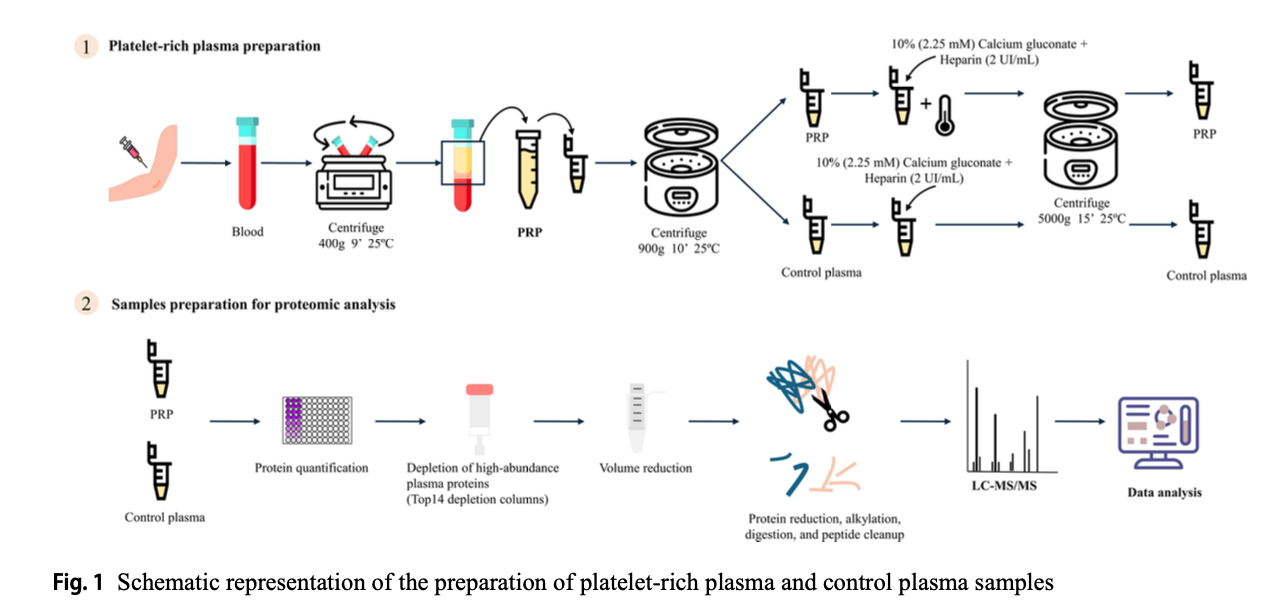
Methods PRP and control plasma samples from 32 elderly donors were obtained by sequential centrifugation of blood samples. PRP platelets were activated with calcium gluconate and heparin, followed by centrifugation to remove residual platelets. Proteomic analysis was performed following depletion of high-abundance proteins, protein digestion, liquid chromatography-tandem mass spectrometry, and bioinformatic analysis.
Results A total of 1,378 proteins were identified in the PRP and control plasma samples, with 324 proteins detected only in PRP. Inter-individual variability in protein detection was observed among PRP samples. Functional analysis of the proteins in PRP, whether only found in PRP or shared with control plasma, showed they were linked to vesicle transport, immune and coagulation processes, cytoskeleton organization, and wound healing. Proteins showing inter-individual variability across samples were linked to tissue regeneration processes, highlighting potential variability in regenerative capacity.
Conclusions PRP from elderly individuals contains a wealth of proteins that play a crucial role in tissue regeneration. These findings support the potential clinical use of autologous PRP for regenerative medicine in elderly individuals. Moreover, the observed inter-individual variability in the PRP proteome highlights opportunities for personalized therapeutic applications.
Keywords Platelet-rich plasma · PRP · Plasma · Proteomics · Mass spectrometry · Tissue regeneration






Leave a Reply