

Authors: Llop-Guevara A, Pellegrino AB, Pimentel I, Villacampa G, Solinas C, Torres-Esquius S, Campanini N, Simonetti S, Tommasi C, Serra O, Corianò M, Boggiani D, Michiara M, Minari R, Bortesi B, Rapacchi E, Dieci MV, Lambertini M, Zoppoli G, Schirone A, Casarini C, Cretella E, Cortesi L, Silini EM, Saura C, Willard-Gallo K, Boisson A, Musolino8 A, Serra V, Balmaña J, Cruz C
DOI: https://doi.org/10.1038/s41523-026-00920-5
Keywords: Biomarkers, Cancer, Oncology, Breast Cancer, Genetics
Advances in breast cancer (BC) therapy are limited by the absence of well-established biomarkers for DNA-damage targeted treatments.
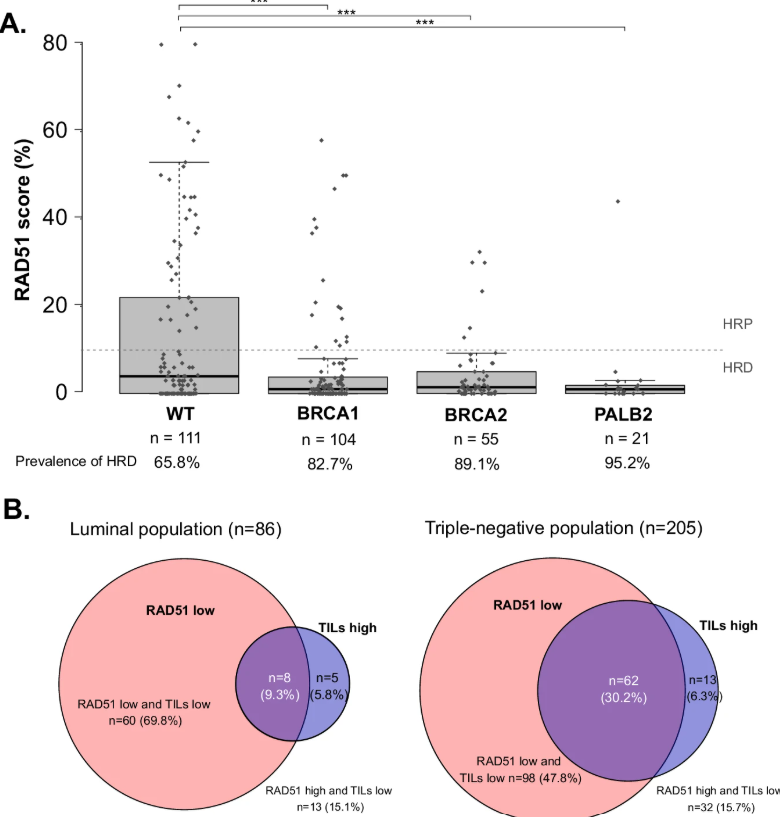
We evaluated the predictive and prognostic value of homologous recombination repair (HRR) deficiency (HRD) by RAD51 nuclear foci and stromal tumour-infiltrating lymphocytes (TILs) in early-stage BC patients with suspected germline susceptibility.
Among 291 patients, HRD by RAD51 was found in 78.4% of tumours, and 69.8% had low TILs (<30%). In 178 patients treated with neoadjuvant chemotherapy, pathologic complete response (pCR) was higher in those with HRD vs HRR-proficient (HRP) tumours (52.3% vs 36.4%); RAD51 remained independently associated with pCR (p = 0.03).
Overall survival (OS) favoured HRD, with 5-year OS of 89.2% vs 82.8% in HRP (p = 0.009), with stronger evidence in triple-negative TILs-low disease (p = 0.005). These findings support RAD51-based HRD assessment as a predictive and prognostic biomarker that may guide treatment decisions in early-stage BC.









Leave A Comment