PhD

Roger Casals co-authors a Benchmarking study on Multimodal Gene Regulatory Networks

By |2026-09-01T09:35:56+00:00December 27, 2024|CBBL News, News, PhD, Publications|

We are thrilled to announce the publication of a new preprint, “Comparison and evaluation of methods to infer gene regulatory networks from multimodal single-cell data”, led by Pau Badia-i-Mompel as the first author, with contributions from Roger Casals and the Saez-Lab team.

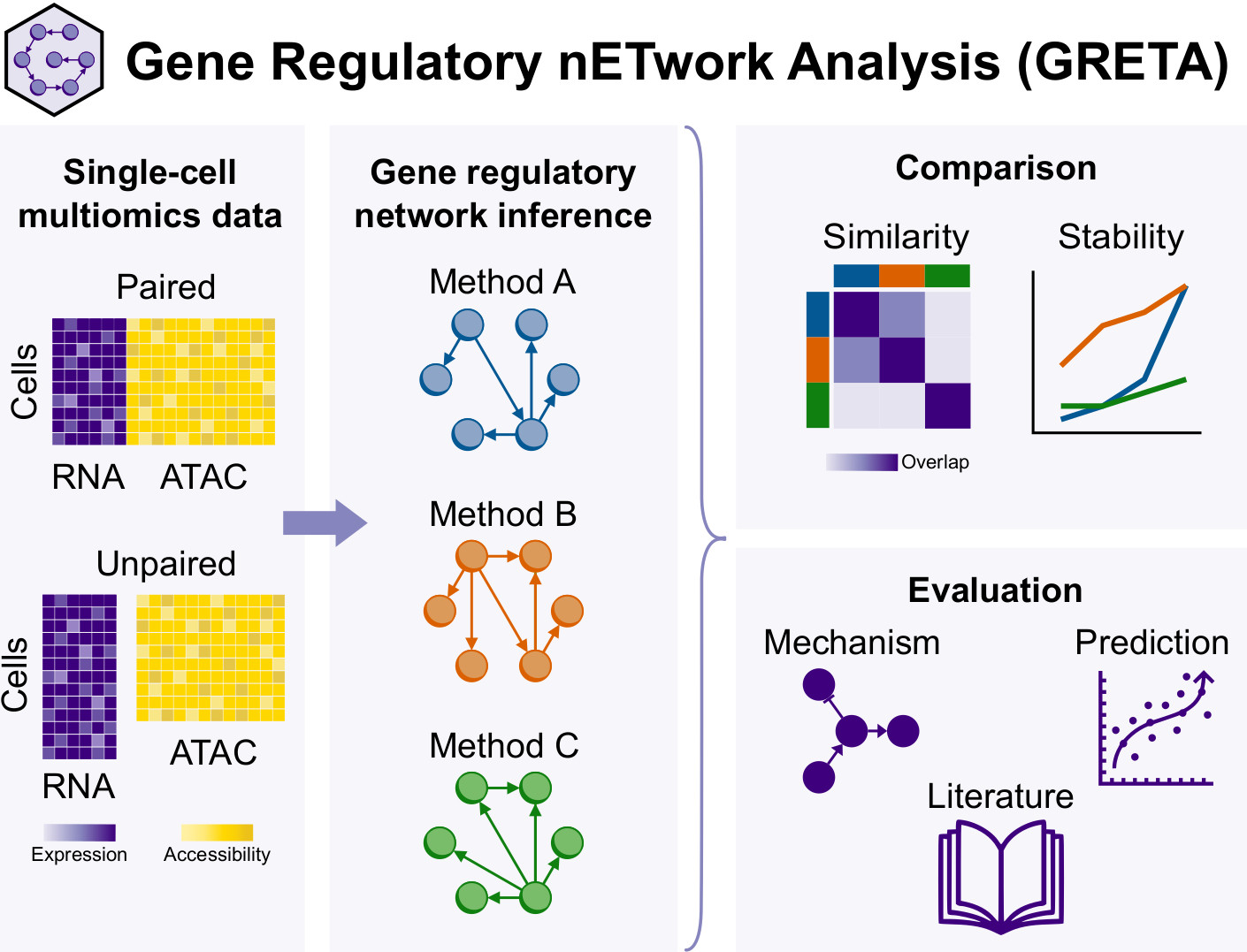
In this work, we present Gene Regulatory nETwork Analysis (GRETA), a comprehensive framework designed to infer, compare, and evaluate gene regulatory networks (GRNs). Using GRETA, we benchmarked both multimodal and unimodal GRN inference methods, setting a foundation for future advancements in the field.

GRETA graphical abstract

This preprint is an important step in understanding multiomic gene regulatory networks and reflects the collaborative efforts of the Saez-Lab, under the leadership of Julio Saez-Rodriguez.

Check out the results and tools here:

If you want to stay updated or join the discussion, check out our announcement on BlueSky.


Roger Casals presents his immunotherapy research at the SEBiBC congress

By |2026-09-01T09:36:04+00:00October 19, 2024|CBBL News, Conferences, PhD|

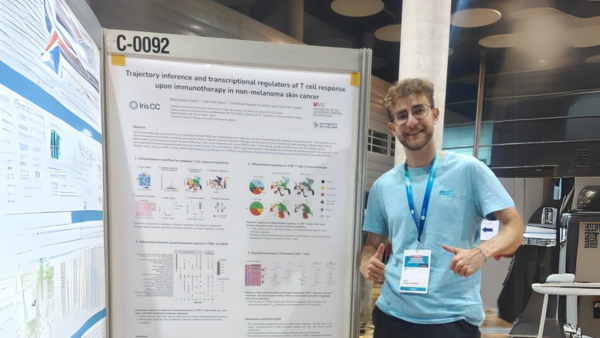
Roger Casals has participated in the first congress of the Spanish Society of Bioinformatics and Computational Biology (SEBiBC), presenting the poster entitled “Trajectory inference and transcriptional regulators of T cell response upon immunotherapy in non-melanoma skin cancer”. The congress, held at the Fira de Valencia from October 16 to 18, brought together prominent researchers in the field of bioinformatics and computational biology, consolidating itself as a success in its first edition.

In his presentation, Casals presented the results of a study that allows mapping the differentiation trajectories of T cells in the tumor microenvironment. Through a comprehensive functional analysis, the work identifies key transcription factors in the modulation of the immune response after immunotherapy in cases of non-melanoma skin cancer. These findings may be a basis for better understanding the mechanisms of response to immunotherapy, opening doors to future personalized therapies.

The work of Roger Casals has been possible thanks to the collaboration with Lara Nonell, expert in bioinformatics from the Vall d’Hebron Institute of Oncology (VHIO), as well as with the support of her doctoral co-tutors, Adrián López García de Lomana from the University of Iceland and Jordi Villà-Freixa.

Roger Casals, selected to present a poster for the Award of Computing in Oncology (VHIO)

By |2026-09-01T09:37:01+00:00February 22, 2024|CBBL News, Conferences, PhD|

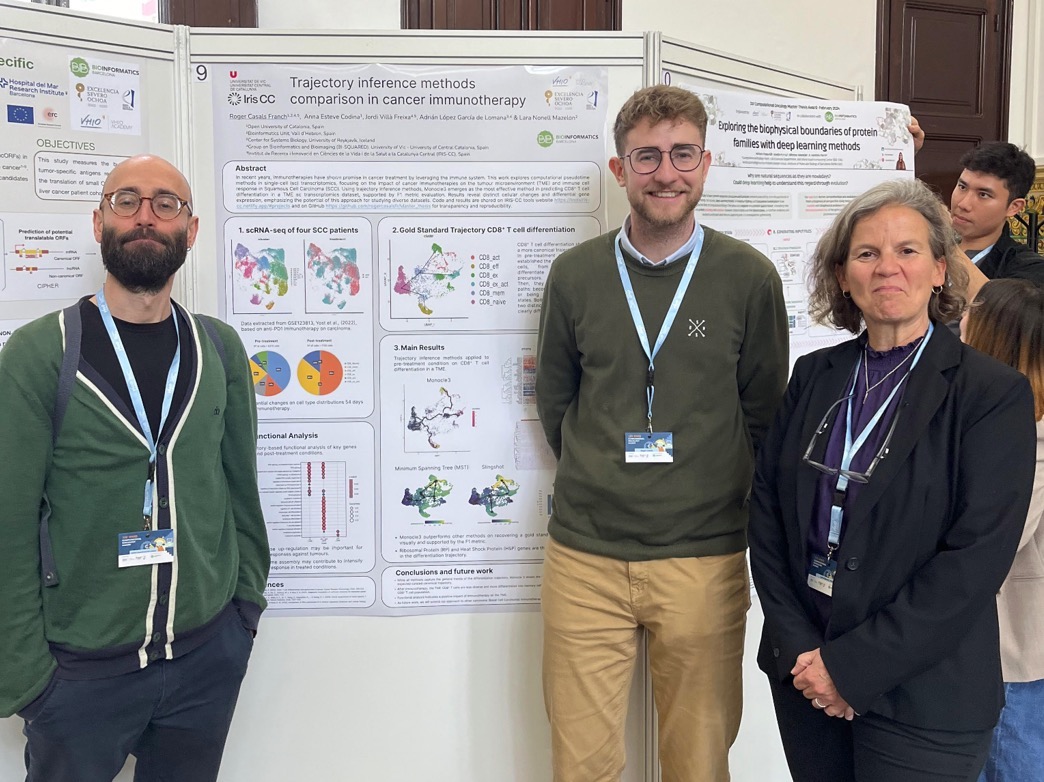
Roger Casals, UVIC-UCC PhD student in the Bioinformatics program and member of the CBBL, was selected to present the poster “Trajectory Inference Methods Comparison in Cancer Immunotherapy” at the first edition of the Award of Computing in Oncology, organized by the Vall d’Hebron Institute of Oncology (VHIO).

The contest was held on February 21, 2024 at the Casa Convalescència in Barcelona and was a meeting to recognize the best master’s thesis in computational science at national level.

Roger works in the analysis of “single-cell” transcriptomics data, which allows analyzing gene expression at scale individual cells, revealing crucial details about biology.

This work has been supervised by Lara Nonell i Mazelon (VHIO), Jordi Villà i Freixa (UVic-UCC / IRIS-CC) and Adrián López García de Lomana (UVic-UCC, HI), and has had the support of the “Programa Investigo AGAUR” (2023 INV-200003TG1) at as a technologist at the IRIS-CC.

Workshop of the Interuniversity PhD program in Bioinformatics

By |2026-09-01T09:37:38+00:00January 24, 2023|CBBL News, PhD|

On February 3rd, the PhD program in Bioinformatics, a joint program of the UAB, UB, UdG, UdL, UOC, UPC, URV and UVic-UCC universities, in collaboration with the Bioinformatics Barcelona association (@BiBcn), will meet at the UVic-UCC Aula Magna to host its annual workshop. In this event, along with presentations and poster sessions by the current students of the program, we will enjoy keynote talks by Dr. Mar Albà (IMIM/ICREA) and Dr. María Ortiz (Bristol Myers Squibb).

You can find the up-to-date details of the workshop at https://mon.uvic.cat/cbbl/outreach/phdworkshop2023/

Attendance is free, but registration is needed. If you plan to attend, please, fill in the form at https://forms.gle/qjub49uRb5JHnvM56.

We hope seeing you in Vic for this good networking event, with topics on

  • Omics and molecular bioinformatics
  • Biomolecular modelling and simulation
  • Systems and synthetic biology
  • Data science in bioinformatics
  • Biostatistics and mathematical modelling in bioinformatics

#phdbioinfo2023

Selected publication: SBMOpenMM; A Builder of Structure-Based Models for OpenMM

By |2026-09-01T09:38:09+00:00December 20, 2021|CBBL News, PhD, Publications|

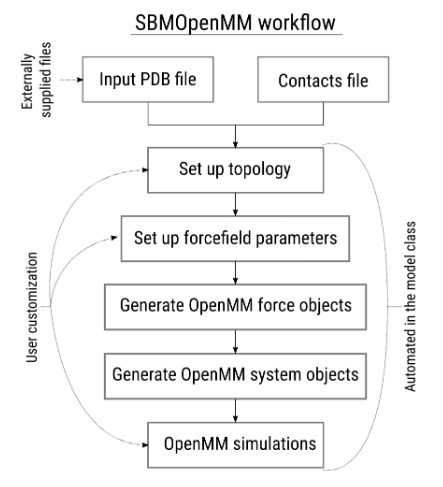
Molecular dynamics (MD) simulations have become a standard tool to correlate the structure and function of biomolecules, and significant advances have been made in the study of proteins and their complexes. A major drawback of conventional MD simulations is the difficulty and cost of obtaining converged results, especially when exploring potential energy surfaces containing considerable energy barriers. This limits the wide use of MD calculations to determine the thermodynamic properties of biomolecular processes. Alternatively, a wide range of Structure-Based Models (SBMs) has been used in the literature to unravel the basic mechanisms of biomolecular dynamics. In a recent article in JCIM, we introduce SBMOpenMM, a Python library to build force fields for SBMs, that uses the OpenMM framework to create and run SBM simulations. The code is flexible, user-friendly, and profits from the high customizability and performance provided by the OpenMM platform.

SBMOpenMM: A Builder of Structure-Based Models for OpenMM

Martin Floor, Kengjie Li, Miquel Estévez-Gay, Luis Agulló, Pau Marc Muñoz-Torres, Jenn K. Hwang, Sílvia Osuna, and Jordi Villà-Freixa
Journal of Chemical Information and Modeling 2021 61 (7), 3166-3171

DOI: 10.1021/acs.jcim.1c00122

Doctorats industrials, la triple hèlix en acció (#DoctoratsIndustrials)

By |2026-09-01T09:38:50+00:00June 8, 2014|CBBL News, PhD, Technology transfer|

Diari ARA, 08/06/2014

La recerca bàsica, malgrat el sotrac de la crisi, ha experimentat al nostre país un avenç sense precedents en els darrers 15 anys, i ens ha situat com a pol d’atracció de talent reconegut internacionalment. En paral·lel, el teixit industrial català surt fortament tocat d’aquesta crisi, però per la seva capacitat de resistència i regeneració comença a donar signes de recuperació. Sortosament, són cada cop més els exemples de la integració de l’R+D+I al disseny i execució de processos productius, però encara som lluny d’exemples exitosos d’altres regions. Per obtenir les sinergies necessàries en aquest procés de reflotament, és imprescindible, doncs, un major diàleg entre els mons de la universitat i l’empresa.

És en aquest context que la Generalitat de Catalunya va llançar el 2012 una proposta engrescadora per incorporar talent a les empreses allà on han de reforçar el seu creixement. El Govern va identificar que la transferència de coneixement havia de donar pas a la concurrència d’interessos entre ambdós mons, i és en els recursos humans on aquesta col·laboració universitat-empresa s’accentua.

D’aquest esforç sorgeix el programa de doctorats industrials, en el qual la UVic-UCC té una participació molt activa. De la bona entesa en la triple hèlix empresa-administració-universitat n’estan sorgint propostes que impulsen nova riquesa basada en el coneixement i la seva aplicació que, sens dubte, ens ajudaran a superar aquests moments de depressió econòmica i anímica.

Go to Top