
This week, our researcher Roger Casals presented a poster at ECCB 2026, the 25th European Conference on Computational Biology, held in Geneva and one of the leading events in computational biology, gathering more than 800 posters and 1,500 participants.
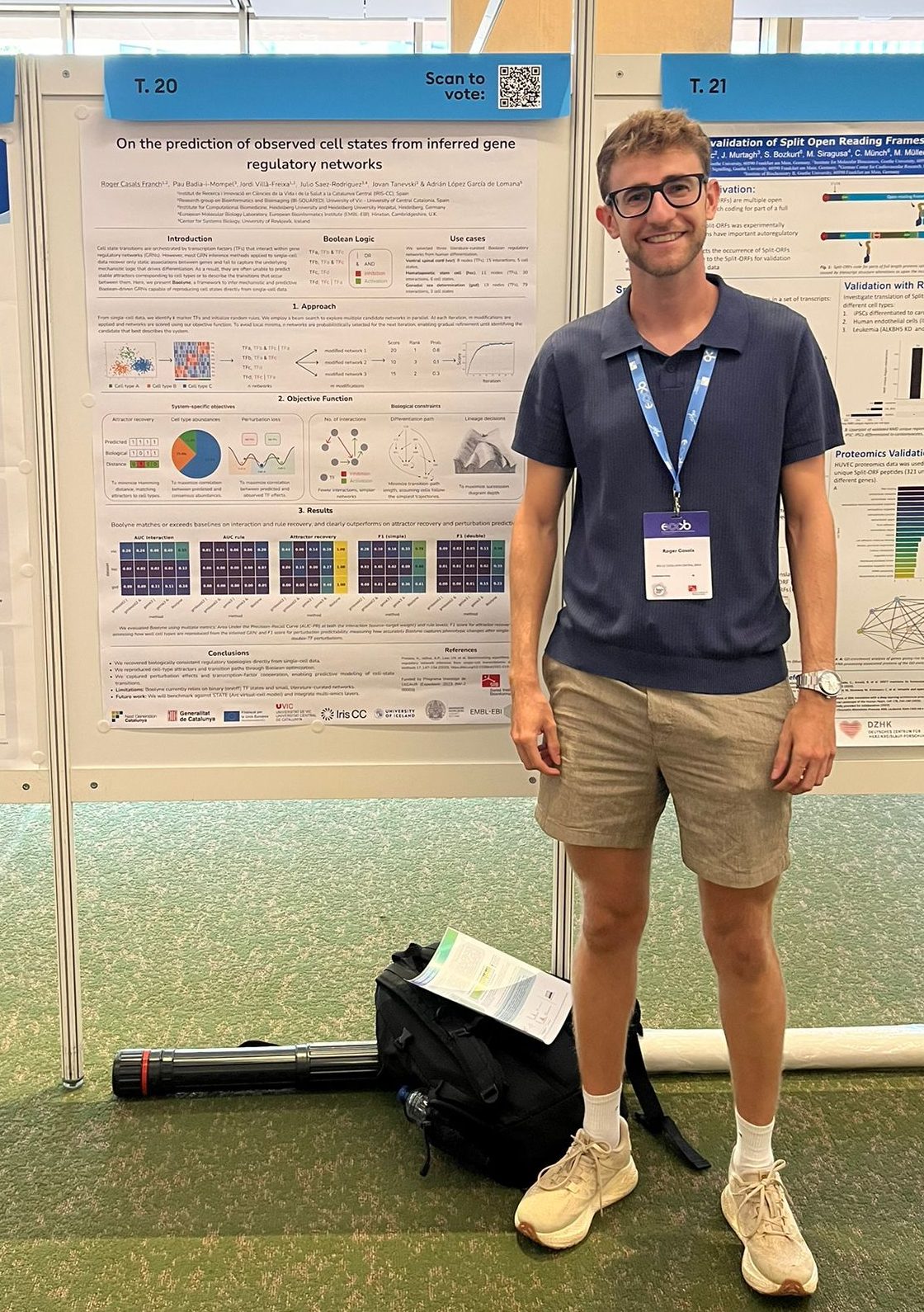
He presented Boolyne, a framework for inferring gene regulatory networks (GRNs) directly from single-cell data. Most GRN inference methods only recover static associations between genes, so they can’t explain the mechanistic logic that drives how cells differentiate. Boolyne instead learns Boolean-driven networks that reproduce real cell states and the transitions between them, with the aim of building a genuinely predictive model—one that can anticipate how cells respond to perturbations rather than just describe what’s already been observed.
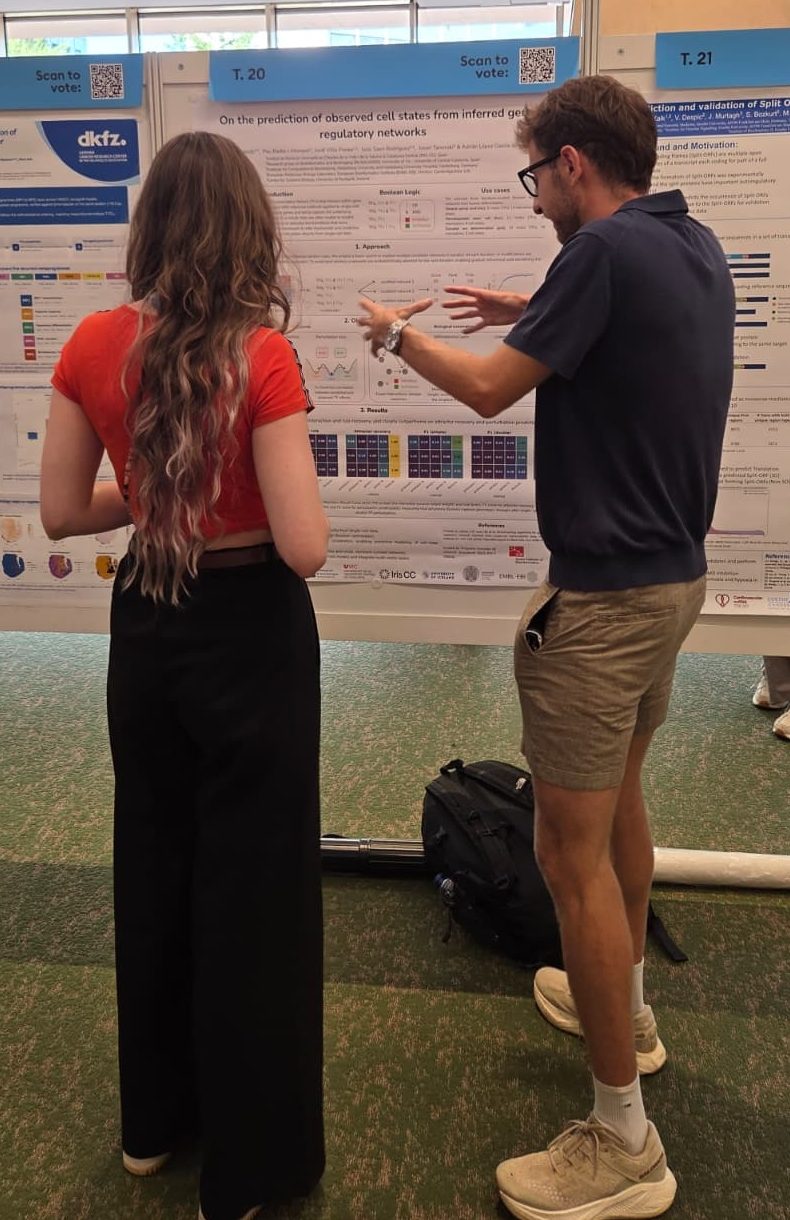
Beyond the results, events like ECCB are a valuable chance to exchange ideas with the wider community and bring new questions back to our research.
Work carried out with Pau Badia-i-Mompel, Jordi Villà-Freixa, Julio Saez-Rodriguez, Jovan Tanevski, and Adrián López García de Lomana (IRIS-CC · UVic-UCC · Heidelberg · EMBL-EBI · University of Reykjavík).
This latest result builds on Roger’s earlier work on gene regulatory networks and cell-state transitions from single-cell data, previously presented at scverse 2025 at Stanford, at the XV Bioinformatics Symposium (JBI2025), at the SEBiBC congress, and in the poster selected for the VHIO Award of Computing in Oncology.