

Authors: Crespo-Santiago J*; Jordana X; Gesualdo M; Álvarez A; Andreu C; Mallafré H; Rzymelka V; Galtés I; Otero-Viñas M.
Results in Engineering 2026 Jun;30:110448
DOI: 10.1016/j.rineng.2026.110448
Abstract
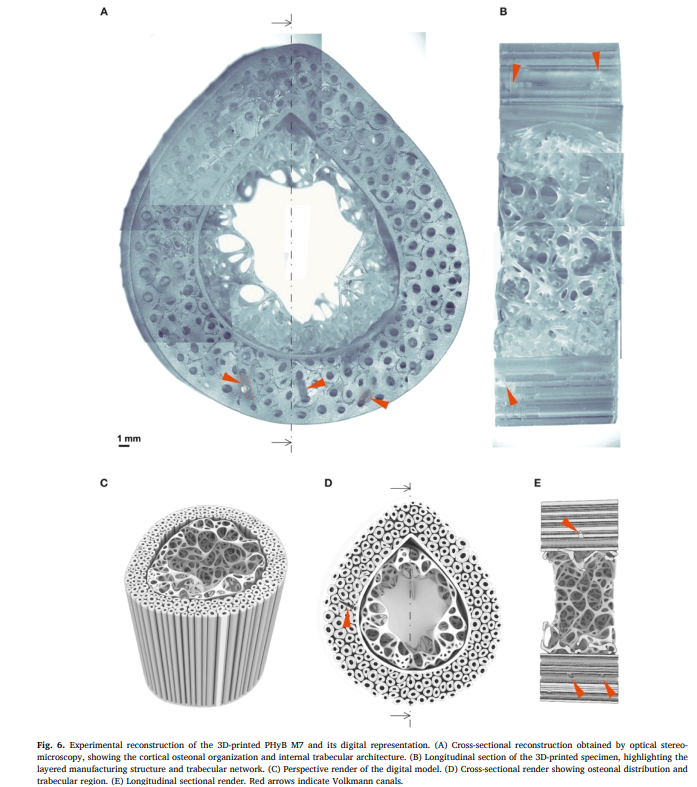
Accurate human bone surrogates are essential for biomechanical research. Existing commercial models provide limited control over microarchitectural features. In this study, we present Phygital Bone (PHyB), a biomimetic and fully customizable 3D-printed bone surrogate developed using algorithm-aided design (AAD) to reproduce key cortical and trabecular structures. PHyB specimens fabricated with commercially available resins were compared with fresh human femur samples and commercial surrogates. Structural validation was performed through micro-computed tomography and histological analysis, confirming the reproduction of osteonal-like organization, lamellar features, and interconnected Haversian and Volkmann canal networks at the designed scale. Mechanical characterization under uniaxial compression showed that selected PHyB configurations exhibit compressive properties within the same order of magnitude as human femur samples under controlled conditions. These results are presented as an initial mechanical benchmarking rather than a comprehensive biomechanical validation. By integrating parametric microarchitectural control with additive manufacturing, PHyB provides a customizable platform for controlled experimental studies and future developments in bone surrogates design.











Leave a Reply