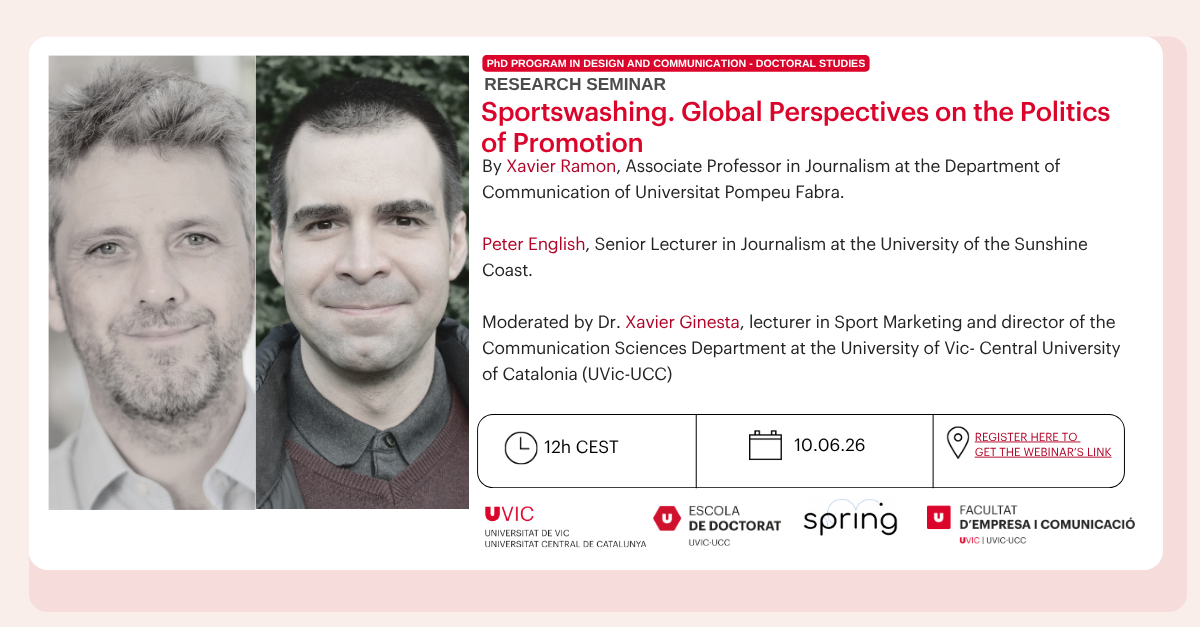
Professors Xavier Ramon and Peter English presented their book project on this topic in SPRING’s third webinar
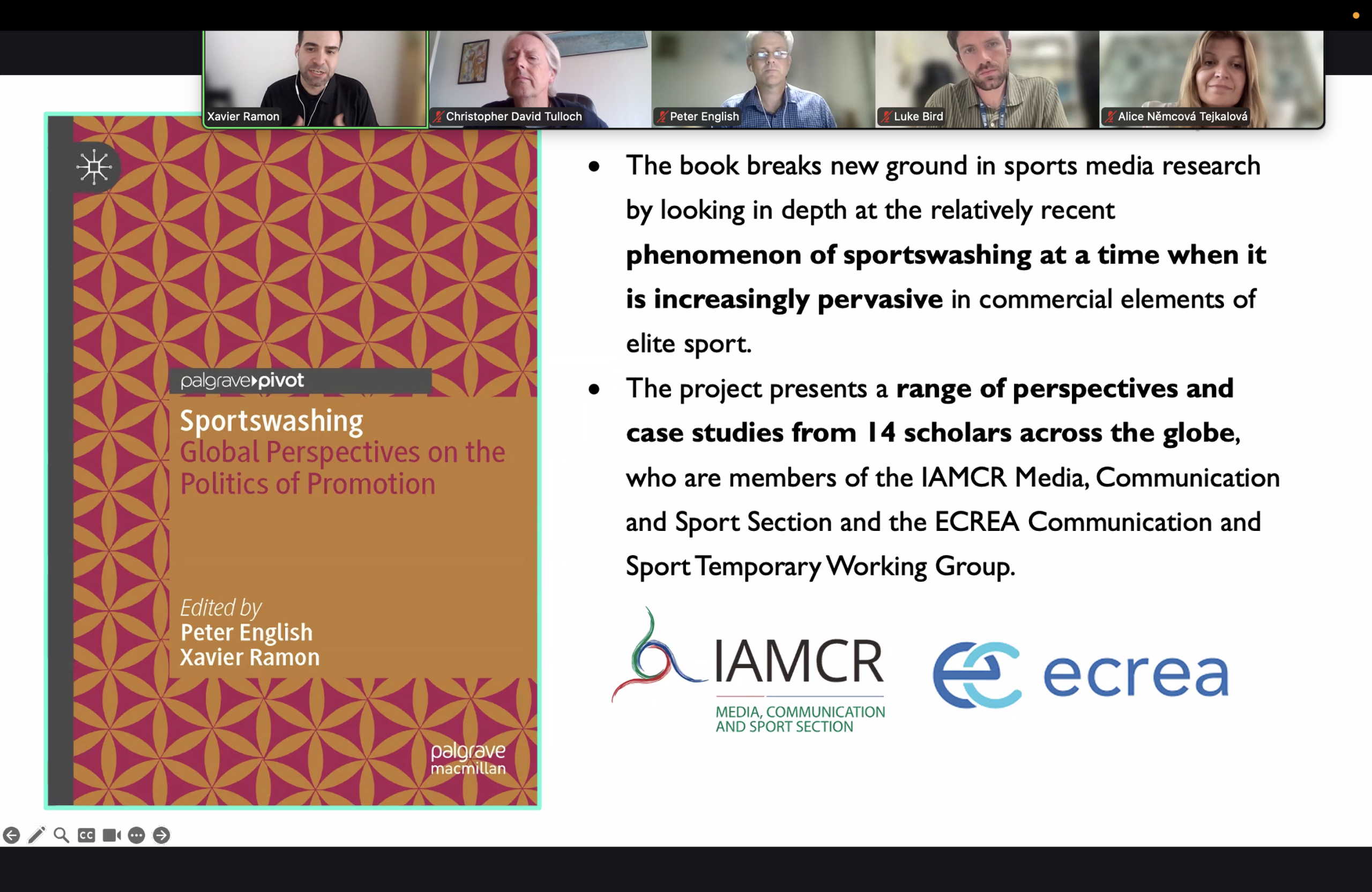
SPRING launched its third webinar with a presentation of the researchers: Dr. Xavier Ramon (PhD, 2016), an Associate Professor in Journalism at the Department of Communication at Universitat Pompeu Fabra (Barcelona), and Dr. Peter English (PhD, 2014), a Senior Lecturer in Journalism at the University of the Sunshine Coast (Australia). The online seminar also featur ed three international researchers: Luke Bird from the University of Auckland (New Zealand), Alice Němcová Tejkalová from Charles University (Czech Republic), and Christopher D. Tulloch from Universitat Pompeu Fabra (Spain). The focus of the webinar was their book project Sportswashing. Global Perspectives on the Politics of Promotion, which is part of the Palgrave Macmillan Pivot series.
The discussion began with an overview of the concept of sportswashing. The two speakers examined this concept through different definitions proposed by various scholars. As Dr. Xavier Ramon explained: “One of the key aspects to consider is the growing presence of the Middle East in sportswashing debates over the past decade”. The discussion then moved on to the nuanced relationship between sportswashing and sports development and whether the concept of sportswashing can be applied to Western nations. Authors provided further examples, including the figure of Donald Trump and his relationship with sport in the light of mega-events such as the FIFA 2026 World Cup and the Los Angeles 2028 Summer Olympics. Finally, they concluded by emphasizing a central idea of their book, as Dr. Peter English noted: “Sportswashing attempts to cleanse certain state behaviours through sport”.
In the following part of the webinar, international researchers introduced earlier provided an overview of the global and local implications of sportswashing through specific case studies. The first presentation was delivered by Alice Němcová Tejkalová, who focused on the Olympic and Paralympic Games, analysing cases such as Athens 2004, Beijing 2008, Sochi 2014, and Rio 2016. As her presentation highlighted, Greece and Brazil were among the countries most concerned with improving their international reputation. As she concluded: “There are several aspects to consider in the future, such as gender”. The second speaker, Luke Bird, examined Visit Saudi’s planned partnership with the 2023 FIFA Women’s World Cup, which was dropped after ‘resistance’ by different actors. His presentation addressed issues related to human rights groups and media coverage, political and organisational factors, and the voices of athletes. As he noted: “The opinions of football players were crucial” in resisting sportswashing practices. The third researcher, Christopher D. Tulloch, focused on the case of the Premier League. He highlighted that sportswashing is also present in English football. In particular, he argued that sportswashing can be observed in the creation of new products, the hosting of European competitions, and direct investment in clubs. In this regard, he added: “Some clubs, such as Manchester City, Sheffield United, and Newcastle United, have ownership links to Gulf states”.
In the Q&A session, participants raised questions about methodological aspects, the influence of national and international audiences, and the future of sportswashing. The webinar concluded with expressions of gratitude to the panelists and attendees.