A new publication, to which Susanna Bodoy from Molecular BioMedicine UVic-UCC has contributed, was published last September in the journal Nature Metabolism under the title “Slc7a7 licenses macrophage glutaminolysis for restorative functions in atherosclerosis.”
What is the main scientific objective addressed in the article, and why is it relevant?
The objective of the article is to investigate how glutamine transport through the SLC7A7 transporter regulates the metabolic function of macrophages in the context of atherosclerosis, a chronic inflammatory disease.
What methodology was used? Why?
The study employs a methodology that combines in vitro, in vivo, and transcriptomic analyses. Bone marrow–derived macrophages are used with genetic manipulations (silencing Slc7a7, Gls1, and Glul) and pharmacological treatments to analyze metabolic changes. In parallel, murine models with specific deletions and atherogenic diets are used to validate the effects on plaque development. This combined approach enables a translational understanding of the role of glutamine in macrophage plasticity and function in atherosclerosis.
What are the main results of the study?
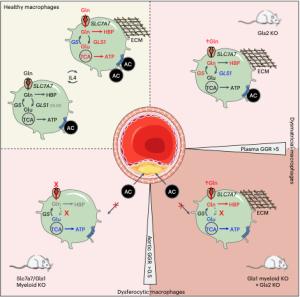
The results show that the resolving capacity of macrophages in atherosclerosis depends on glutamine uptake through the SLC7A7 transporter, which fuels glutaminolysis via GLS1. Macrophage-specific deletion of Slc7a7 reduces glutamine influx, alters cellular metabolism, decreases ATP production, and contributes to a more aggressive progression of atherosclerosis. Finally, it is also demonstrated that the metabolic and transcriptional reprogramming of macrophages is modulated by glutamine degradation, affecting extracellular matrix remodeling and plaque stability.
What are the potential applications or implications of these findings in practical terms?
The results of this study open the door to new therapeutic strategies to combat atherosclerosis by modulating macrophage metabolism. More specifically, the SLC7A7 transporter and the GLS1 enzyme could serve as therapeutic targets to stabilize plaques and reduce cardiovascular risk. Additionally, these markers are proposed as tools to improve diagnosis and clinical prediction in patients with atherosclerosis.
What are the next steps based on these findings? What future research directions are proposed, and are there unanswered questions?
Future work will focus on exploring how modulation of glutamine metabolism can improve macrophage function in atherosclerosis, and on investigating how factors such as diet or the microbiome influence glutamine degradation. It is also necessary to better understand metabolic differences between macrophage subtypes and their impact on the progression of atherosclerosis