
More than 60 participants joined the event in Vic and online to share the results, experiences and future perspectives of the Erasmus+ Happy Power project.
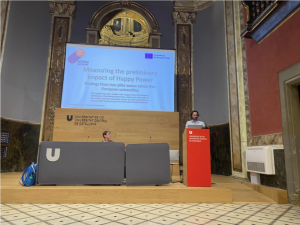
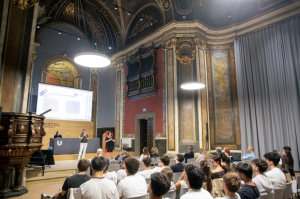
On 29 September 2026, the University of Vic – Central University of Catalonia (UVic-UCC) hosted the Happy Power Final International Conference, under the title “Building Healthier Universities through Positive Psychology”
More than 60 people participated in the event, both in person at the Paranimf of UVic-UCC and online, bringing together university teachers, students, researchers and people interested in wellbeing and Positive Psychology in Higher Education.
The conference marked an important moment after three years of cooperation between the five Happy Power partner universities: UVic-UCC (Spain), Oulu University of Applied Sciences – OAMK (Finland), Università degli Studi di Milano (Italy), “Vasile Alecsandri” University of Bacău (Romania) and Artevelde University of Applied Sciences (Belgium).
Why wellbeing matters in Higher Education
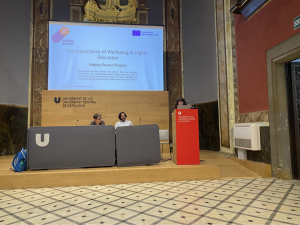
The conference opened with Elisenda Tarrats, Professor at UVic-UCC and coordinator of the Happy Power project, who presented “The Importance of Wellbeing in Higher Education”
Her presentation highlighted that universities are not only places for academic and professional learning. They can also play an important role in supporting students’ personal development, emotional wellbeing and resilience.
Over the three years of the project, Happy Power has developed into a European community involving more than 80 university teachers and over 5,000 students.
The Happy Power learning pathway combines classroom activities with individual activities through a web app. Students are encouraged to connect Positive Psychology concepts with their own experiences and everyday situations, developing self-awareness, constructive thinking and personal resources related to wellbeing.
Preliminary results from the Happy Power pilots
One of the central parts of the conference was the presentation of the preliminary quantitative results, based on two pilot waves implemented across the five partner universities.
The combined sample included 897 students who completed both the initial and final assessments. Of these, 609 participated in the experimental group and 288 in the control group. A total of 289 participants were students from UVic-UCC.
The evaluation analysed different dimensions, including physical, psychological, social and environmental quality of life, perseverance, optimism and depressive symptoms.
Among the preliminary findings, the experimental group showed a significant improvement in psychological quality of life after the intervention. These findings are preliminary and should be interpreted considering the study design and the differences between university contexts.
Giving a voice to students and teachers
An important part of Happy Power has been learning directly from the students and teachers who experienced the programme.
During the conference, Annekatrien Depoorter from Artevelde University of Applied Sciences; Sanna Rönkkö and Ulla-Maija Törmälä from OAMK; and Gabi Mares from the University of Bacău shared experiences and lessons collected throughout the project.
Feedback from participants has been essential to improve Happy Power. Based on their experiences, the project team simplified some learning activities, made reflection exercises more student-centred, included more practical examples, reduced the workload of some activities and improved the clarity and consistency of the materials and translations.
The future of Positive Psychology in Higher Education
The second part of the conference included the keynote “The Future of Positive Psychology in Higher Education”, delivered by David Gallardo-Pujol, Professor at the University of Barcelona.
His presentation offered a critical and future-oriented perspective on Positive Psychology. One of the main ideas was the importance of asking what works, for whom, when and under which conditions, considering the interaction between personal characteristics, situations and time.
He also highlighted that flourishing is more than the absence of psychological difficulties and that wellbeing should be understood from a broader perspective, including autonomy, competence and relationships with others.
A legacy beyond the end of the project
Although the Final International Conference marks the closing stage of the European project, Happy Power does not end here.
The project leaves a collection of training materials, resources for teachers, activities for students and digital tools that can continue supporting the integration of Positive Psychology and wellbeing into Higher Education.
The Happy Power online course and training materials are already available so that teachers, students and university staff can continue using the resources developed during the project. The current Happy Power website provides direct access to the course through the Ubiqua platform.
Access the Happy Power Online Course & Materials
After three years of collaboration, Happy Power leaves not only results and educational resources, but also a European community of teachers and students committed to building healthier universities and promoting wellbeing through Positive Psychology.
Happy Power – Erasmus+ Cooperation Partnership Project
2023-1-ES01-KA220-HED-000153853
Co-funded by the European Union


Deixeu un comentari