Category Archives: CBBL News

Workshop of the Interuniversity PhD program in Bioinformatics

Posted by 24 de January de 2023

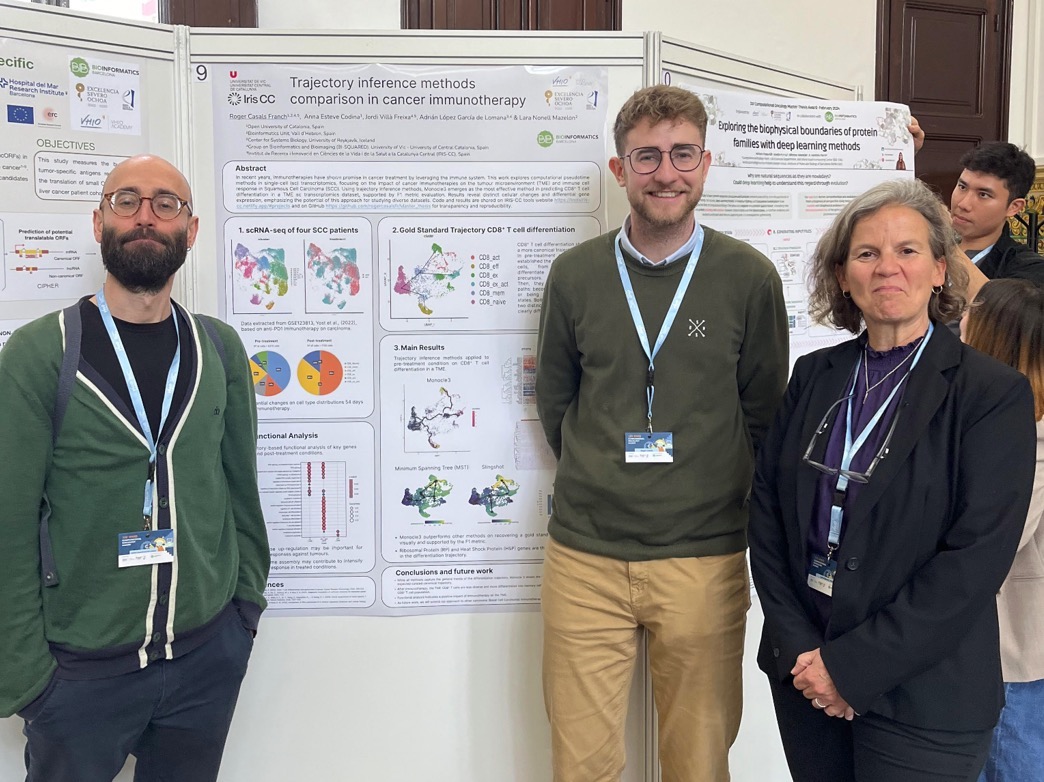
On February 3rd, the PhD program in Bioinformatics, a joint program of the UAB, UB, UdG, UdL, UOC, UPC, URV and UVic-UCC universities, in collaboration with the Bioinformatics Barcelona association (@BiBcn), will meet at the UVic-UCC Aula Magna to host its annual workshop. In this event, along with presentations and poster sessions by the current students of the program, we will enjoy keynote talks by Dr. Mar Albà (IMIM/ICREA) and Dr. María Ortiz (Bristol Myers Squibb).

You can find the up-to-date details of the workshop at https://mon.uvic.cat/cbbl/outreach/phdworkshop2023/

Attendance is free, but registration is needed. If you plan to attend, please, fill in the form at https://forms.gle/qjub49uRb5JHnvM56.

We hope seeing you in Vic for this good networking event, with topics on

  • Omics and molecular bioinformatics
  • Biomolecular modelling and simulation
  • Systems and synthetic biology
  • Data science in bioinformatics
  • Biostatistics and mathematical modelling in bioinformatics

#phdbioinfo2023

Ancient loss of catalytic selenocysteine spurred convergent adaptation in a mammalian oxidoreductase

Posted by 10 de January de 2023

Selenocysteine (Sec), the 21st amino acid specified by the genetic code, is a rare selenium-containing residue found in the catalytic site of selenoprotein oxidoreductases. Sec is analogous to the common cysteine (Cys) amino acid but its selenium atom offers physicalchemical properties not provided by the corresponding sulfur atom in Cys. Catalytic sites with Sec in selenoproteins of vertebrates are under strong purifying selection but one enzyme, Glutathione Peroxidase 6 (GPX6), independently exchanged Sec for Cys less than one hundred million years ago in several mammalian lineages. We reconstructed and assayed these ancient enzymes before and after Sec was lost and up to today, and found them to have lost their classic ability to reduce hydroperoxides using glutathione (GSH). This loss of function, however, was accompanied by bursts of amino acid changes in the catalytic domain, with protein sites concertedly changing under positive selection across distant lineages abandoning Sec in GPX6. This demonstrates that when sulfur in Cys impairs catalysis a narrow evolutionary path is followed, with epistasis and pleiotropy leading to convergent evolution and triggering enzymatic properties likely beyond those in classic GPXs. These findings are an unusual example of adaptive convergence towards unexplored oxidoreductase functions during mammalian evolution.

  • Preprint: Ancient loss of catalytic selenocysteine spurred convergent adaptation in a mammalian oxidoreductase. Jasmin Rees, Gaurab Sarangi, Qing Cheng, Martin Floor, Aida M Andrés, Baldomero Oliva Miguel, Jordi Villà-Freixa, Elias SJ Arnér, Sergi Castellano BioRxiv doi: https://doi.org/10.1101/2023.01.03.522577
  • Published article: Ancient Loss of Catalytic Selenocysteine Spurred Convergent Adaptation in a Mammalian Oxidoreductase. Jasmin Rees, Gaurab Sarangi, Qing Cheng, Martin Floor, Aida M Andrés, Baldomero Oliva Miguel, Jordi Villà-Freixa, Elias S J Arnér, Sergi Castellano Genome Biology and Evolution, Volume 16, Issue 3, March 2024, evae041, https://doi.org/10.1093/gbe/evae041

Dynamic chromatin association of IκBα is regulated by acetylation and cleavage of histone H4

Posted by 20 de December de 2021

IκBs exert principal functions as cytoplasmic inhibitors of NF-kB transcription factors. Additional roles for IκB homologues have been described, including chromatin association and transcriptional regulation. Phosphorylated and SUMOylated IκBα (pS-IκBα) binds to histones H2A and H4 in the stem cell and progenitor cell compartment of skin and intestine, but the mechanisms controlling its recruitment to chromatin are largely unknown. In a recent paper led by Lluís Espinosa at IMIM, the team showed that serine 32–36 phosphorylation of IκBα favors its binding to nucleosomes and demonstrate that p-IκBα association with H4 depends on the acetylation of specific H4 lysine residues. The N-terminal tail of H4 is removed during intestinal cell differentiation by proteolytic cleavage by trypsin or chymotrypsin at residues 17–19, which reduces p-IκBα binding. Inhibition of trypsin and chymotrypsin activity in HT29 cells increases p-IκBα chromatin binding but, paradoxically, impaired goblet cell differentiation, comparable to IκBα deletion. Taken together, the results indicate that dynamic binding of IκBα to chromatin is a requirement for intestinal cell differentiation and provide a molecular basis for the understanding of the restricted nuclear distribution of p-IκBα in specific stem cell compartments.

In summary:

Nuclear IκBα preferentially binds the acetylated N-terminal tail of histone H4 in vivo, specifically in the skin and intestine stem cell compartments. N-terminal cleavage of histone H4 facilitates IκBα dissociation and cellular differentiation.

    • Nuclear IκBα binds the acetylated N-terminal tail of histone H4.
    • The N-terminal tail of histone H4 is lost during cellular differentiation.
  • Histone H4 cleavage is likely produced by Trypsin and Chymotrypsin.
  • Cellular differentiation requires dynamic IκBα chromatin binding and dissociation.

Laura Marruecos, Joan Bertran, Daniel Álvarez-Villanueva, María Carmen Mulero, Yolanda Guillén, Luis G Palma, Martin Floor, Anna Vert, Sara Arce-Gallego, Irene Pecharroman, Laura Batlle, Jordi Villà-Freixa, Gourisankar Ghosh, Anna Bigas, Lluís Espinosa. Dynamic chromatin association of IκBα is regulated by acetylation and cleavage of histone H4. EMBO Reports (2021)22:e52649 2021 https://doi.org/10.15252/embr.202152649

See also comment by Maarten Dhaenens in EMBO Reports.

Selected publication: SBMOpenMM; A Builder of Structure-Based Models for OpenMM

Posted by 20 de December de 2021

Molecular dynamics (MD) simulations have become a standard tool to correlate the structure and function of biomolecules, and significant advances have been made in the study of proteins and their complexes. A major drawback of conventional MD simulations is the difficulty and cost of obtaining converged results, especially when exploring potential energy surfaces containing considerable energy barriers. This limits the wide use of MD calculations to determine the thermodynamic properties of biomolecular processes. Alternatively, a wide range of Structure-Based Models (SBMs) has been used in the literature to unravel the basic mechanisms of biomolecular dynamics. In a recent article in JCIM, we introduce SBMOpenMM, a Python library to build force fields for SBMs, that uses the OpenMM framework to create and run SBM simulations. The code is flexible, user-friendly, and profits from the high customizability and performance provided by the OpenMM platform.

SBMOpenMM: A Builder of Structure-Based Models for OpenMM

Martin Floor, Kengjie Li, Miquel Estévez-Gay, Luis Agulló, Pau Marc Muñoz-Torres, Jenn K. Hwang, Sílvia Osuna, and Jordi Villà-Freixa
Journal of Chemical Information and Modeling 2021 61 (7), 3166-3171

DOI: 10.1021/acs.jcim.1c00122

Modeling of New Mutations in HFE2 and TFR2 Genes Causing Non HFE-Related Hereditary Hemochromatosis

Posted by 20 de December de 2021

Hereditary hemochromatosis (HH) is an iron metabolism disease clinically characterized by excessive iron deposition in parenchymal organs such as liver, heart, pancreas, and joints. It is caused by mutations in at least five different genes. HFE hemochromatosis is the most common type of hemochromatosis, while non-HFE related hemochromatosis are rare cases. Here, we describe six new patients of non-HFE related HH from five different families. Two families (Family 1 and 2) have novel nonsense mutations in the HFE2 gene have novel nonsense mutations (p.Arg63Ter and Asp36ThrfsTer96). In this new collaborative article led by Mayka Sánchez from the Department of Basic Sciences at UIC Barcelona, our lab gave the structural context for the effect of the identified mutations in TFR2 interactions.

Comparative modeling of the TFR2 dimer complexed with TF. (A) TFR2 chains are shown in cyan and pink, while TF chains are shown in green and orange. Dimeric interactions between TFR2 chains, close to Asp680 position (red circle at the α-15 helix, pink chain), are made between residues in the α-18 helix of one TFR2 chain (pink chain) and the loop located between the β-6 and β-7 strands of the other (cyan chain). (B) Sequence alignment of the TFR1 and TFR2 proteins near the TFR2 680 position (green arrow). Numbering is according to the TFR1 sequence, and the secondary structure depiction is based on the TFR1 structure (PDB ID 1CX8). The alignment coloring was produced by the ESPript 3.0 web server [40], where position with red background means absolute sequence conservation. (C–E) Structural context of positions TFR1-Asp648 (C, purple), TFR2-Asp680 (D, pink), and TFR2-Asp680Tyr (E, magenta). Residue names of TFR1/2 appear in white, while residues in TF are in black. Significant interactions are shown with dashed lines.


Hernández, G.; Ferrer-Cortès, X.; Venturi, V.; Musri, M.; Pilquil, M.F.; Torres, P.M.M.; Rodríguez, I.H.; Mínguez, M.À.R.; Kelleher, N.J.; Pelucchi, S.; Piperno, A.; Alberca, E.P.; Ricós, G.G.; Giró, E.C.; Pérez-Montero, S.; Tornador, C.; Villà-Freixa, J.; Sánchez, M. New Mutations in HFE2 and TFR2 Genes Causing Non HFE-Related Hereditary Hemochromatosis. Genes 2021, 12, 1980. https://doi.org/10.3390/genes12121980

A new period for the CBBL

Posted by 21 de December de 2014

The computational biochemistry and biophysics laboratory was created at the UPF in 2003 and remained there until May 2012, when I moved to the UVic-UCC. After a couple of years of strong managerial work that diverted the main research efforts of the lab, it is now rebuilding with evolved lines of research within the framework of the Bioinformatics and Medical Statistics Research Group. To make the story short, the CBBL devotes more and more to collaborative work with experimentalists, and a number of projects dealing with computational structural biology are being undertaken by the lab members. See the publications page for more details.

On the other hand, the interest of the lab to develop its own tools when needed is more than alive, and the combination between methodological development and applied research is the driving force of our members.

Doctorats industrials, la triple hèlix en acció (#DoctoratsIndustrials)

Posted by 8 de June de 2014

Diari ARA, 08/06/2014

La recerca bàsica, malgrat el sotrac de la crisi, ha experimentat al nostre país un avenç sense precedents en els darrers 15 anys, i ens ha situat com a pol d’atracció de talent reconegut internacionalment. En paral·lel, el teixit industrial català surt fortament tocat d’aquesta crisi, però per la seva capacitat de resistència i regeneració comença a donar signes de recuperació. Sortosament, són cada cop més els exemples de la integració de l’R+D+I al disseny i execució de processos productius, però encara som lluny d’exemples exitosos d’altres regions. Per obtenir les sinergies necessàries en aquest procés de reflotament, és imprescindible, doncs, un major diàleg entre els mons de la universitat i l’empresa.

És en aquest context que la Generalitat de Catalunya va llançar el 2012 una proposta engrescadora per incorporar talent a les empreses allà on han de reforçar el seu creixement. El Govern va identificar que la transferència de coneixement havia de donar pas a la concurrència d’interessos entre ambdós mons, i és en els recursos humans on aquesta col·laboració universitat-empresa s’accentua.

D’aquest esforç sorgeix el programa de doctorats industrials, en el qual la UVic-UCC té una participació molt activa. De la bona entesa en la triple hèlix empresa-administració-universitat n’estan sorgint propostes que impulsen nova riquesa basada en el coneixement i la seva aplicació que, sens dubte, ens ajudaran a superar aquests moments de depressió econòmica i anímica.

#CienciaSMW

Posted by 21 de February de 2014

Jordi Villà-Freixa, invited speaker at the event on “Internet i les eines de social media en la comunicació de la ciència”, during the 2014 Social Media Week at the Centre de Cultura Contemporània de Barcelona (CCCB).

In recent years the Internet and social networks have rapidly become part of many aspects of our daily lives. Facebook, Twitter, Google+, YouTube… make it easier to stay in touch with family and friends, join conversations of interest online and have access to more audiovisual material than there are hours in the day to watch’ l! Its ability to quickly spread and amplify content and to do so in an informal environment means that the Internet and social networks have become powerful tools to use in a professional context and also to attract and involve people in different causes.

The Web is today the great platform for researching scientific information, both specialized and dissemination. However, most scientists are yet to use these platforms to communicate their research. In this sense, science communicators can also make great use of it, beyond the online portals of the media where they work or the blogs where they publish their articles. It is in recent years that Facebook and Twitter have begun to be used as tools for the promotion and dissemination of their work or scientific information of general interest.

How to communicate science to society through the Internet and which ways to use to take advantage of the full potential of the Web remains a field that needs to be explored and exploited with more knowledge and tools.

This is why the Secretariat of Universities and Research of the Generalitat de Catalunya has organized a conference  as part of Social Media Week Barcelona (#SMWBCN). Coinciding with the commemoration of the three hundredth anniversary of the events of 1714, this day is included in the Tricentenary programme. The commemoration, launched by the Generalitat de Catalunya under the slogan “Érem.Som.Serem”, wants to transcend the historical perspective and is presented as an opportunity to share spaces for reflection and dialogue that allow us to jointly rethink a future project.

The conference brought together experts from companies such as Google, Yahoo and the BBC as well as working scientists, journalists specializing in science, university and research center communications managers to discuss the following issues:

  • How can you create attractive, potentially viral content on the Internet?
  • What are the formats with the most possibilities for disseminating science on the Web? it is everything invented on the internet or is there still room for innovation? What are the future trends?
  • What possibilities do Twitter, Facebook, YouTube… offer to communicate science? How can you get the most out of it to build a name on the Internet?
  • How can a platform like Facebook help create and position a brand a Internet? How can it benefit a research center to disseminate its work and obtain funding for future projects?

PROGRAM


SMWBCN2014.key