

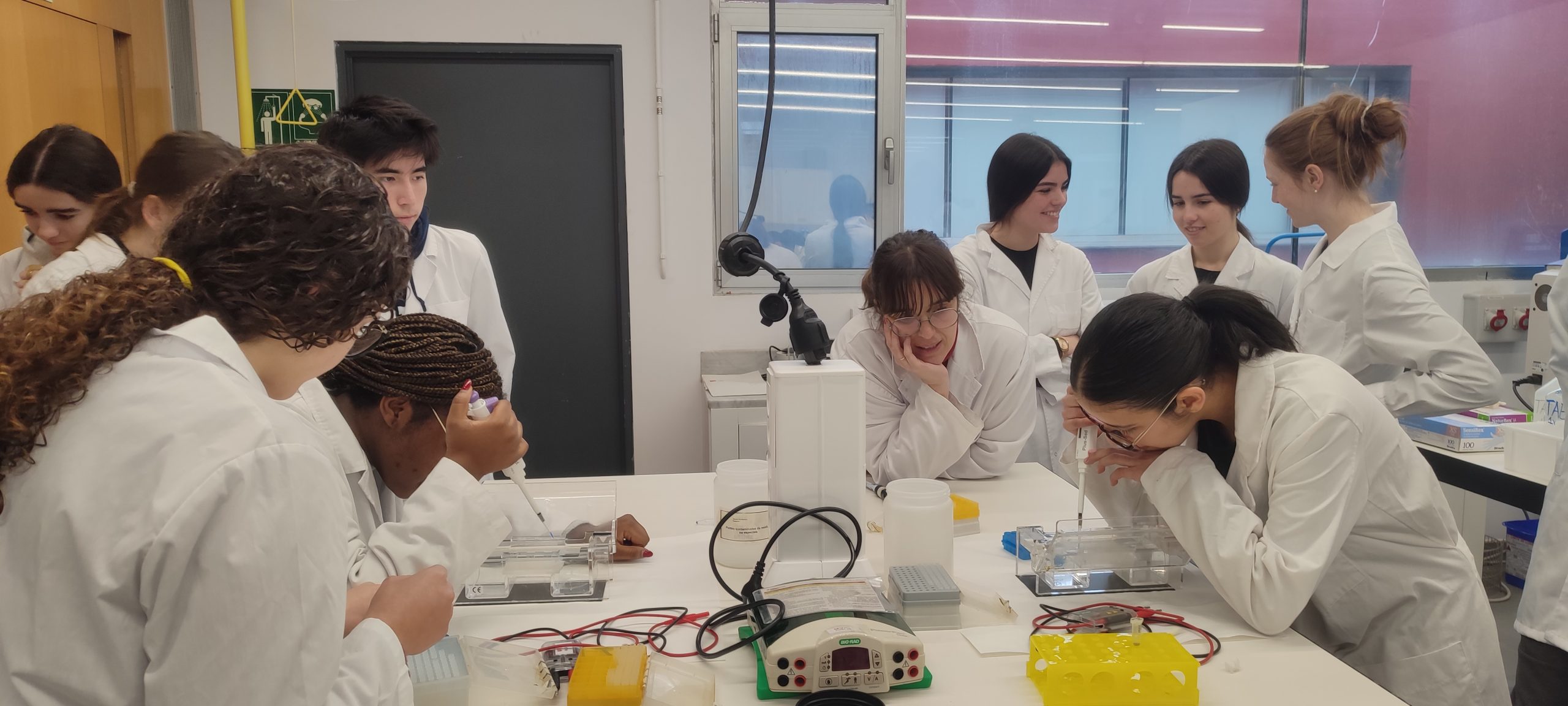
The Biomedical Workshops are a well-established scientific outreach initiative promoted by TR2Lab within the framework of the Educational Biomedicine Program. The program is aimed at upper secondary (baccalaureate) students and seeks primarily to strengthen the bridge between scientific education at school level and university studies in the biomedical field. At the same time, these workshops serve as a valuable platform to bring biomedical sciences closer to young people, stimulate emerging scientific vocations, and channel students’ curiosity and interest in research.
In this edition, 171 students from secondary schools in Osona and Vallès took part in the workshops, providing highly positive feedback. To better understand the real impact of the initiative on everyday teaching practice, we spoke with Ariadna Palacios i Prat, Biology and Geology teacher at Col·legi Sant Miquel dels Sants in Vic and Head of the Science and Technology Department.
How did you first learn about these workshops?
Our participation in these workshops is the result of a long-standing relationship between Col·legi Sant Miquel dels Sants and the University of Vic. It was Enric Roca, former Head of the Science Department, who first became involved in the programme. This collaboration has been maintained and strengthened over the years. At our school, we firmly support collaboration with UVic across different fields of knowledge and actively take part in initiatives such as the “Llegint Ciència” award and the Scientific Literature Discussion Groups. Therefore, joining these biology workshops was a natural step for us.
What do these workshops bring to your teaching?
These workshops offer a practical and tangible perspective on content that we usually cover in a more theoretical way in the classroom. For students, the opportunity to work in a university laboratory is extremely appealing. Even though we have a well-equipped school lab, access to a university environment allows them to become familiar with advanced scientific instrumentation.
What surprised me most the first time I attended—and what I consider a major added value—is the strong practical focus of the workshop. Beyond the theoretical foundations, students are the true protagonists of the experimental work. The availability of resources and the student-to-equipment ratio ensure that everyone can actively participate and develop procedural skills that are difficult to acquire in other contexts.
Which parts of the curriculum are reinforced through these workshops?
These workshops allow us to put into practice curricular concepts that often remain highly theoretical in the classroom. For example, the serum protein detection workshop using electrophoresis is particularly useful for first-year upper secondary students, as it helps them understand the structure and properties of proteins. Beyond the technique itself, students grasp the underlying principle of separating molecules based on charge and mass.
The workshop also includes activities such as preparing solutions, which creates a natural link with Chemistry. We use this example in class to highlight the importance of interdisciplinarity across subjects.
For second-year students, the genetic fingerprinting workshop is key to grounding the biotechnology unit. Working directly with concepts such as DNA replication, PCR, and the use of restriction enzymes helps students consolidate essential topics for the university entrance exams (PAU). Seeing real-world applications of these techniques makes the content far more understandable.
One aspect we value highly is that students are not simply following a “recipe”. They are required to think critically and to work with the rigor and safety standards expected in a real laboratory. Ultimately, the workshops help students not only memorize steps, but also understand the scientific rationale behind their work.
How do students experience the workshops? What do they value most?
Overall, students are very satisfied. A clear sign of this is that those who attend in their first year are always eager to repeat the experience in their second year. What they value most, without a doubt, is the participatory and hands-on nature of the activity. They do not find the workshop boring—probably because they feel actively involved in the process.
Another key factor is being able to see the real, practical application of concepts that they had previously only encountered in the classroom.
Do the workshops contribute to students’ motivation and academic orientation? Do you have any examples?
I believe these workshops have a direct impact on students’ motivation, especially in the second year of upper secondary education. Working in a university environment helps them envision themselves as future university students and scientists—something that can sometimes be difficult to achieve in everyday school life.
In fact, this year, at the end of the session, a couple of students asked me which degree programs they could pursue in order to work in research in this field. I think the experience acts as a small window into the daily reality of scientific research, and that is highly motivating.
The Biomedical Workshops for upper secondary students took place in January in the Biosciences laboratories of the Faculty of Science, Technology and Engineering at UVic-UCC. The sessions were delivered by Anna Buisan, PhD candidate in the Medicine and Biomedical Sciences program; Dr. Bet Sarri, Associate Professor at the Faculty of Medicine; Dr. Cristina Bancells Bau, Lecturer at the Faculty of Medicine; and Dr. Laia Bosch-Presegué, Lecturer at the Faculty of Health Sciences and Wellbeing. The workshops also received technical support from Cristina Martín and David Benito, laboratory technicians in the Biosciences Area at UVic-UCC.
All four instructors are researchers at TR2Lab, affiliated with the Institute for Research and Innovation in Life and Health Sciences of Central Catalonia (IRIS-CC), and are actively involved in biomedical research carried out within the framework of UVic-UCC.
This activity was supported by the 2025 grants for the organization of scientific outreach and research training activities from the Vice-Rectorate for Research and Knowledge Transfer, with the collaboration of the Scientific Outreach Unit of UVic-UCC.




Leave a Reply