Category Archives: CBBL

Roger Casals co-authors a Benchmarking study on Multimodal Gene Regulatory Networks

Posted by 27 de December de 2024

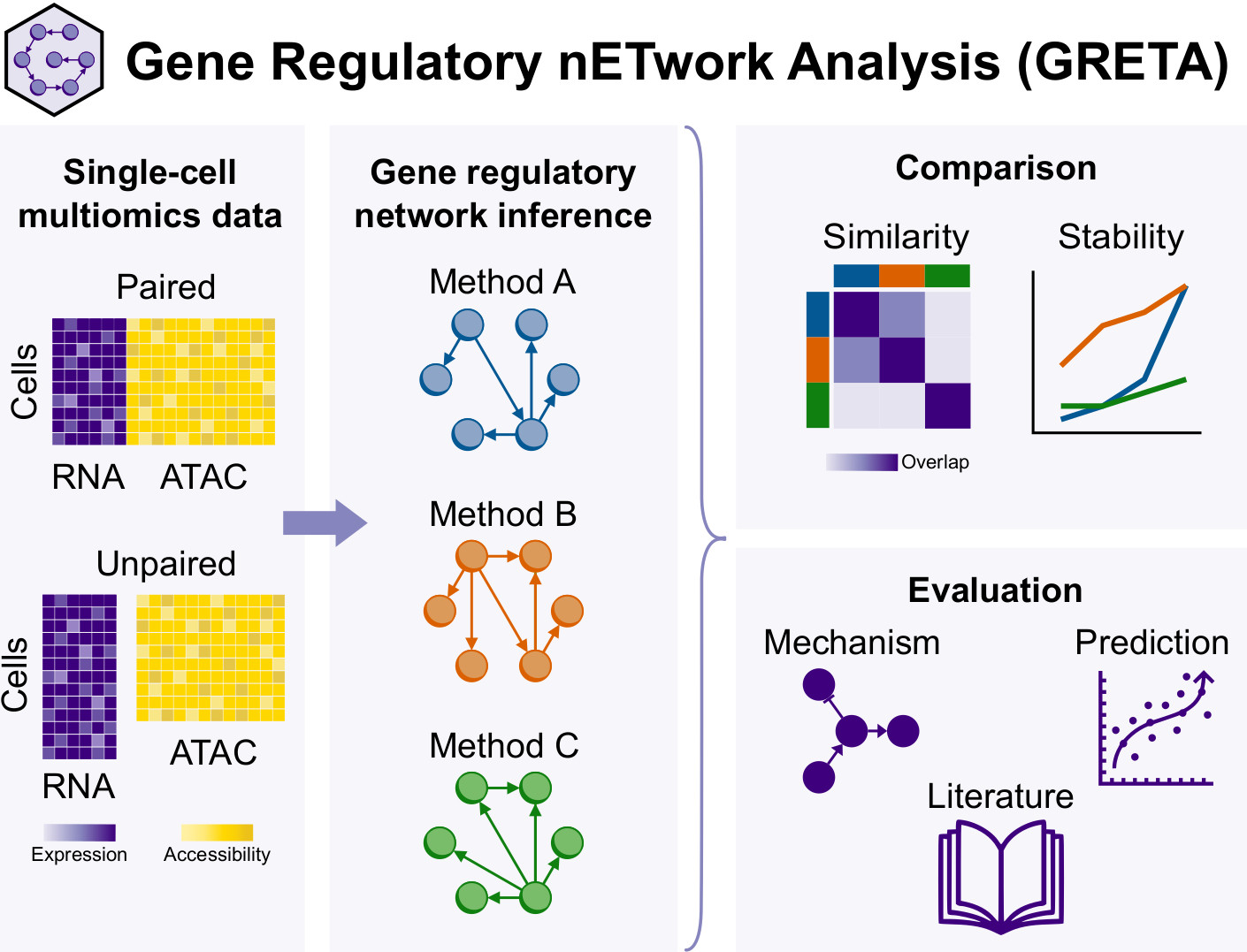
We are thrilled to announce the publication of a new preprint, “Comparison and evaluation of methods to infer gene regulatory networks from multimodal single-cell data”, led by Pau Badia-i-Mompel as the first author, with contributions from Roger Casals and the Saez-Lab team.

In this work, we present Gene Regulatory nETwork Analysis (GRETA), a comprehensive framework designed to infer, compare, and evaluate gene regulatory networks (GRNs). Using GRETA, we benchmarked both multimodal and unimodal GRN inference methods, setting a foundation for future advancements in the field.

GRETA graphical abstract

This preprint is an important step in understanding multiomic gene regulatory networks and reflects the collaborative efforts of the Saez-Lab, under the leadership of Julio Saez-Rodriguez.

Check out the results and tools here:

If you want to stay updated or join the discussion, check out our announcement on BlueSky.


Dynamic chromatin association of IκBα is regulated by acetylation and cleavage of histone H4

Posted by 20 de December de 2021

IκBs exert principal functions as cytoplasmic inhibitors of NF-kB transcription factors. Additional roles for IκB homologues have been described, including chromatin association and transcriptional regulation. Phosphorylated and SUMOylated IκBα (pS-IκBα) binds to histones H2A and H4 in the stem cell and progenitor cell compartment of skin and intestine, but the mechanisms controlling its recruitment to chromatin are largely unknown. In a recent paper led by Lluís Espinosa at IMIM, the team showed that serine 32–36 phosphorylation of IκBα favors its binding to nucleosomes and demonstrate that p-IκBα association with H4 depends on the acetylation of specific H4 lysine residues. The N-terminal tail of H4 is removed during intestinal cell differentiation by proteolytic cleavage by trypsin or chymotrypsin at residues 17–19, which reduces p-IκBα binding. Inhibition of trypsin and chymotrypsin activity in HT29 cells increases p-IκBα chromatin binding but, paradoxically, impaired goblet cell differentiation, comparable to IκBα deletion. Taken together, the results indicate that dynamic binding of IκBα to chromatin is a requirement for intestinal cell differentiation and provide a molecular basis for the understanding of the restricted nuclear distribution of p-IκBα in specific stem cell compartments.

In summary:

Nuclear IκBα preferentially binds the acetylated N-terminal tail of histone H4 in vivo, specifically in the skin and intestine stem cell compartments. N-terminal cleavage of histone H4 facilitates IκBα dissociation and cellular differentiation.

    • Nuclear IκBα binds the acetylated N-terminal tail of histone H4.
    • The N-terminal tail of histone H4 is lost during cellular differentiation.
  • Histone H4 cleavage is likely produced by Trypsin and Chymotrypsin.
  • Cellular differentiation requires dynamic IκBα chromatin binding and dissociation.

Laura Marruecos, Joan Bertran, Daniel Álvarez-Villanueva, María Carmen Mulero, Yolanda Guillén, Luis G Palma, Martin Floor, Anna Vert, Sara Arce-Gallego, Irene Pecharroman, Laura Batlle, Jordi Villà-Freixa, Gourisankar Ghosh, Anna Bigas, Lluís Espinosa. Dynamic chromatin association of IκBα is regulated by acetylation and cleavage of histone H4. EMBO Reports (2021)22:e52649 2021 https://doi.org/10.15252/embr.202152649

See also comment by Maarten Dhaenens in EMBO Reports.

Selected publication: SBMOpenMM; A Builder of Structure-Based Models for OpenMM

Posted by 20 de December de 2021

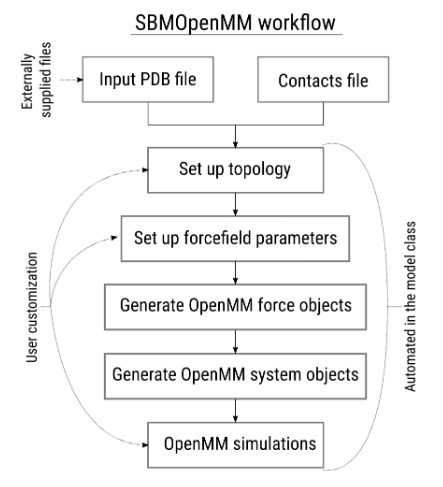
Molecular dynamics (MD) simulations have become a standard tool to correlate the structure and function of biomolecules, and significant advances have been made in the study of proteins and their complexes. A major drawback of conventional MD simulations is the difficulty and cost of obtaining converged results, especially when exploring potential energy surfaces containing considerable energy barriers. This limits the wide use of MD calculations to determine the thermodynamic properties of biomolecular processes. Alternatively, a wide range of Structure-Based Models (SBMs) has been used in the literature to unravel the basic mechanisms of biomolecular dynamics. In a recent article in JCIM, we introduce SBMOpenMM, a Python library to build force fields for SBMs, that uses the OpenMM framework to create and run SBM simulations. The code is flexible, user-friendly, and profits from the high customizability and performance provided by the OpenMM platform.

SBMOpenMM: A Builder of Structure-Based Models for OpenMM

Martin Floor, Kengjie Li, Miquel Estévez-Gay, Luis Agulló, Pau Marc Muñoz-Torres, Jenn K. Hwang, Sílvia Osuna, and Jordi Villà-Freixa
Journal of Chemical Information and Modeling 2021 61 (7), 3166-3171

DOI: 10.1021/acs.jcim.1c00122

New model for CFTR

Posted by 5 de July de 2012

The CBBL has completed part of the work of a three years long project on translational bioinformatics in cystic fibrosis (Activa). Our main role in the project was the determination of a model structure for CFTR, the chloride channel whose mutations are in the basis of the disease, as well as being a target for acute watery diarrhea drugs.

The new model, built in collaboration with Nir Ben-Tal’s lab at Tel Aviv University, proposes an open conformation of the channel, oposite to previous models, paving the way for the development of new drugs for both activation and blocking of the channel.

Janusz Bujnicki at the PRBB

Posted by 13 de March de 2012

Next Monday March 19 we will host the visit of Dr. Janusz Bujnicki , from the Laboratory of Bioinformatics and Protein Engineering at the International Institute of Molecular and Cell Biology, Warsaw, Poland.
The conference is included in the PRBB/CRG series of conferences and is open to everybody in the PRBB interested in the subject. It will be at 12:00 in the seminar room Marie Curie on the ground floor.

Seminar Title: “New methods for Structural Bioinformatics of RNA and RNPs”
Host: Jordi Villà i Freixa, Research Group on Biomedical Informatics ( GRIB) IMIM-UPF

X Barril – UB – Structure-based drug design: Towards accurate predictions of thermodynamic and kinetic parameters

Posted by 28 de February de 2012

Xavier Barril is visiting the PRBB this friday to give a seminar on the title topic.

Here it comes a short abstract of the talk:

The combination of increased availability of structural information, major boosts in computational power and methodological developments is
taking structure-based drug discovery to a higher level. I will present the main research lines of the group, focussing on the development of a new type of docking scoring functions and the elucidation of structure-kinetics relationships. Together with new experimental methods, these type of tools will enable the discovery of drugs with more diverse and effective mechanisms of action.

Nir Ben Tal, hosted by the CBBL

Posted by 20 de February de 2012

PRBB-CRG Seminar Reminder: Monday February 20: Nir Ben Tal, University of Tel Aviv, Israel

Today we will host the visit of Dr. Nir Ben Tal, from the Department of Biochemistry and Molecular Biology, The George S.Wise Faculty of Life Sciences, Tel Aviv University, Israel.

The seminar is included in the PRBB-CRG conference series and is open to everybody in the PRBB interested in the subject. It will be at 12 in the seminar room Marie Curie on the ground floor of the PRBB.

Seminar Title: “Human Copper transporter 1: Model Structure, functional dynamics and Selectivity”
Host: Dr.Jordi Villà-Freixa, GRIB, UPF

FRIDAY Nov.18th – 11h; Structural Biology Seminar (Dr. Agustí Emperador)

Posted by 16 de November de 2011

PRBB structural biology seminar

Dr. Agustí Emperador, Institut for Research in Biomedicine (IRB, Barcelona)

“Protein flexibility in docking with discrete molecular dynamics simulations”

The aim of protein-protein docking is to predict how two proteins associate to form a complex. This means determining where will be the interface. This is a complex problem with many degrees of freedom. To reduce the sampling space, in general both proteins are considered to be rigid bodies (rigid docking). This reduces the problem to 6 degrees of freedom (3 for translation and 3 for rotation). The rigid body docking is a rude approach, since the proteins have flexibility and may undergo relevant conformational changes upon binding to the other protein when forming the complex. We have used discrete molecular dynamics (DMD) simulations to include the protein flexibility in docking configurations, and we have improved the predictive power of the method. DMD is a simplified molecular dynamics method much faster than standard MD, specially for systems with less that 10^3 particles.

Friday, November 18th 2011; 11:00-12:00
Seminar Room “Xipre” 173.06 (PRBB – 1st floor)

Researchers in trouble at the CIPF, Valencia

Posted by 9 de November de 2011

I reprduce here the original letter sent by Rafael Pulido, from the CIPF, where he explains the current loss of jobs at his institution. This is a warning on the starting to be dramatical situation of the Spanish research system, a system that has consolidated in the last decades as probably the most active in the South of Europe.

ERE EN EL CIPF DE VALENCIA

Estimados compañer@s,

Sorprendentemente, la mayor parte de los científicos españoles sigue sin saber que en el Centro de Investigación Príncipe Felipe (CIPF) de Valencia se ha puesto en marcha, hace dos semanas, un severísimo ERE (sí, leéis bien: un expediente de regulación de empleo) que va a dejar en la calle a más de 100 personas de este centro de investigación (entre personal científico y de apoyo). La causa aducida para el ERE es de tipo económico, debido principalmente a la reducción de más del 50% en el presupuesto de funcionamiento del CIPF, que procede de la Conselleria de Sanitat de la Generalitat Valenciana. El ERE presentado contempla el cierre de 16 laboratorios, 14 líneas de investigación y la mayoría de los servicios tecnológicos, lo que supone el despido de todo el personal científico de los grupos (sí, leéis bien: de todo el personal científico, incluidos los técnicos, becarios, investigadores principales…) y la cancelación y renuncia, por parte del CIPF, de todos los proyectos de esos grupos (sí, leéis bien: proyectos del MICINN, FIS, etc). El resto de laboratorios no se libra, y su personal también se reducirá drásticamente. En tales circunstancias, las agencias financiadoras ya han empezado a anunciar la retirada de las subvenciones de proyectos concedidas a los grupos, porque consideran que éstos no podrán llevar a cabo la investigación para la que fueron concedidos los proyectos. Por si fuera poco, en paralelo a este ERE se ha abierto otro expediente que contempla una reducción salarial, para los que se queden en el centro, de hasta el 60%. El CIPF, que aspiraba a ser el buque insignia de la investigación biomédica en la Comunidad Valenciana, se ha convertido en pocos años, gracias a una nefasta gestión y al abandono de las subvenciones por parte de la Generalitat, en el barco fantasma de la ciencia española. Es la primera vez que un ERE de tal magnitud se aplica a un centro de investigación en Europa, posiblemente en el mundo, y sus consecuencias para la investigación biomédica en España, y sobre todo en la Comunidad Valenciana, van a ser devastadoras. Recibís este correo porque creemos que toda la comunidad científica (investigadores, sociedades científicas, agencias financiadoras, etc) tiene que ser conocedora de esta situación. Por favor, difundid este mensaje en vuestra red de contactos científicos porque, sorprendentemente, la mayoría de los profesionales que hacen ciencia en España siguen sin estar informados del ERE del CIPF. Adjuntamos dos “pósters” (castellano e inglés) que también os animamos a difundir.
Podéis obtener fácilmente información sobre el ERE del CIPF en cualquier buscador, o accediendo a nuestro blog: http://concienciavalencia.blogspot.com

Un saludo

Rafael Pulido Investigador Jefe del Laboratorio de Biología Molecular del Cáncer del CIPF Presidente del Comité de Empresa del CIPF

The CBBL, awarded in the new edition of the “marató de TV3” projects

Posted by 28 de October de 2011

The CBBL team has been awarded in the new edition of the “Marató de TV3” basic research projects call. The awarded project deals with the study of the modulation of microglia/macrophage response by targeting novel immune receptors regulating cell activation and phenotype, which will provide neuroprotection after acute CNS damage.

The role of the CBBL within the consortium is to bring knowledge in the computational modelling of the receptors and their interations with different types of ligands. The project is coordinated by Laia Acarín (Universitat Autònoma de Barcelona), and includes the groups of Carme Solà (CSIC), Joan Sayós (Vall d’Hebron Institut de Recerca) and Hugo Peluffo (Institut Pasteur, Montevideo), as well as the CBBL.

The “marató de TV3”, organized by the Catalan public broadcasting media, has established since 20 years ago as a reference charity in Catalonia and the South of Europe and represents a sublimation of the expectations the general public puts into scientific research of important biomedical problems. Despite the economical difficulties our country is suffering in the last few years, the response of the public to the call for funding is increasing every year, demonstrating a very proactive and cohesive society.

As public researchers we take this new challenge with renovated energy, and taking into account the individual contributions of many anonymous people we will put all our efforts to produce a succesful outcome of the project.

The project will be awarded during the official ceremony that will take place at the UAB on Wednesday, November 9th 2011.

Update: news on the event at the UPF newsletter.