Intersectionality for Change: Opportunities and Challenges in Higher Education Research, Teaching and Policy
Intersectionality for Change: Opportunities and Challenges in Higher Education Research, Teaching and Policy
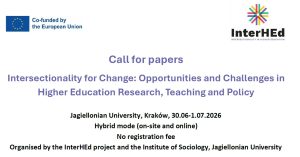
We invite submissions for presentations at Intersectionality for Change: Opportunities and challenges in Higher Education Research, Teaching and Policy, a two-day conference to be held on hybrid mode (on site at Jagiellonian University in Krakow and online) on the 30th June and 1st July 2026, dedicated to exploring how intersectionality is understood, practiced, and contested in higher education. This conference is organised in the framework of the InterHEd project.
Intersectionality has become a key framework for analysing how overlapping structures of power and interlocking axes of inequality shape lived experiences and opportunities. While rooted in a specific legal and political context, it has since travelled across disciplines, regions, and institutional landscapes generating productive tensions, diverse applications, and ongoing contestations. Its increasing visibility in academic, pedagogical, and policy settings raises crucial questions about translation, depoliticization and relevance to local histories and struggles.
Yet scholarship does not always sufficiently consider how intersectional thinking emerging outside dominant contexts enriches or challenges mainstream approaches. Nor has enough attention been paid to how intersectionality is transformed as it becomes embedded in higher education, especially in curriculum design, classroom interaction, assessment practices, student support, and institutional policy. Implementing intersectionality in teaching and learning practices requires educators to reflect on their own positionalities and pedagogical assumptions, and to develop methods that address structural inequalities within the classrooms. Researchers, in turn, face ongoing methodological, theoretical and practical challenges when designing studies capable of capturing intersectional dynamics. There is also a risk that intersectionality may be reduced to managerial or technocratic tools that limit its transformative potential. Ensuring that intersectionality remains a framework for critical inquiry and social change, rather than a simplified administrative category, therefore remains an important challenge for both scholars and practitioners in higher education.
This conference aims to address these gaps by fostering dialogue across different academic stages and professional contexts – bringing together faculty members, students, doctoral researchers, and practitioners working with intersectionality in higher education in diverse ways.
We invite submissions for presentations focusing on theoretical, methodological, and empirical dimensions of intersectionality in higher education (eg. University institutional bodies) and related contexts (eg. public policy, student movements, local communities). Contributions may address (but are not limited to) the following themes:
- Intersectionality in teaching and research: How is intersectionality understood, adapted, or reconfigured in different geopolitical, cultural, and academic contexts? How is intersectionality incorporated into curricula, academic practices, and research designs? What methodological, epistemological, pedagogical and practical challenges arise?
- Emerging axes of inequality in higher education in Europe: Which dimensions of inequality are currently most salient, emergent, or neglected in intersectional analyses in higher education in Europe? How do local histories, political debates, and organisational structures shape the meanings and uses of intersectionality?
- Resistance, contestation and backlash in higher education: How is intersectionality challenged, politicised, or depoliticised within universities and broader public discourse? What concrete forms does backlash against intersectional approaches take within higher education?
- Intersectionality in policy and institutional frameworks: What happens when intersectionality is translated into institutional university policy? Who defines it, and who benefits from its uptake? What tensions emerge when critical frameworks become embedded in institutional practices?
This conference seeks to create a space where these diverse understandings can be explored, contested, and enriched. We encourage submissions that engage critically and creatively with the complexity of intersectionality’s theoretical, empirical and methodological applications in higher education.
Submission guidelines:
- Abstracts (max. 250 words) must be written in English.
- Please include title and 5–6 keywords.
- Please indicate whether your presentation will be delivered on-site or online.
- No registration fee is required.
Send abstracts via link: https://forms.office.com/e/A8gtQy54re by 24 April 2026.
Abstracts will be peer‑reviewed by the InterHEd team. Notification of acceptance will be sent to the lead author by 6 May 2026. For any inquiries, please contact as at: julia.michcik@uj.edu.pl