The Wound Healing Innovation research line at TR2Lab, directed by Ph.D. Marta Otero, focuses on developing personalized, advanced therapeutic strategies to improve the healing of chronic cutaneous wounds.
Our research combines translational approaches with in vitro and ex vivo models to investigate the biological mechanisms underlying impaired tissue repair. We also study the effectiveness of advanced biological therapies -such as autologous platelet-rich plasma (PRP) and punch skin grafting (PSG)- to enhance skin regeneration and re-epithelialization.
Our long-term goals are twofold. First, we aim to deepen the understanding of the fundamental biology of skin repair and regeneration, enabling the design of novel, targeted biological therapies. Second, we work to empower the Clinical Wound Unit, led by specialist nurses, to drive innovation in individualized treatments and improved organizational care processes, ultimately increasing healing rates for chronic wounds.

Team
Our last happenings
Bringing Science Closer to the Classroom for a Second Consecutive Year during European Researchers’ Night 2026
As part of European Researchers' Night 2026, PhD candidate Clara Masó once again visited Els Castanyers School in Viladrau to bring science closer to young students. For the second consecutive year, pupils from 3rd, 4th and 5th grade took part in interactive workshops designed to introduce them to scientific [...]
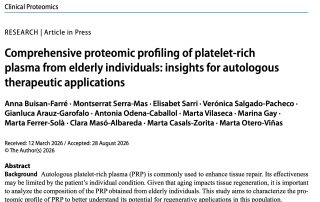
Comprehensive proteomic profiling of platelet-rich plasma from elderly individuals: insights for autologous therapeutic applications
Authors: Anna Buisán-Farré, Montserrat Serra-Mas, Elisabet Sarri, Verónica Salgado-Pacheco, Gianluca Arauz-Garofalo, Antonia Odena-Caballol, Marta Vilaseca, Marina Gay, Marta Ferrer-Solà, Clara Masó-Albareda, Marta Casals-Zorita, Marta Otero-Viñas Clinical Proteomics. 2026 DOI: 10.1186/s12014-026-09630-3 Funding: Instituto de Salud Carlos III (PI19/01379 and PI24/00211), the European Union, the PECT Osona Transformació Social project (001-P-000382), [...]
TR2Lab was present at ETRS 2026 Annual Meeting
Dr.Elisabet Sarri and PhD candidate Natalia Palacio, members of TR2Lab, participated in the ETRS 2026 Annual Meeting, "Research, Repair, Regenerate", held in Rouen, France, from 2 to 4 September 2026. Organized by the European Tissue Repair Society (ETRS), the meeting is recognized as one of the leading international forums for [...]